Edward Antill, 2nd
+ Catharine
+ Anne Morris |
|
[Edward-1st, John]
Edward Antill, 2nd
 (17 Jun 1701, Piscatauqua, NJ) (17 Jun 1701, Piscatauqua, NJ)
(15 Aug 1770, New Brunswick NJ)
 + CatharineBef. 20 Jun 1729
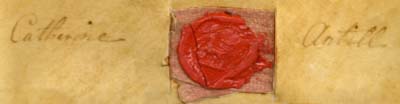
+ Anne Morris 10 Jun 1739
dau of Governor Lewis Morris
(3 Apr 1706, Morrisania, Bronx NY)
(Nov 1781)
Children:
Sarah Amille Antill
[married Lt. Col. John Morris]
Isabel Graham Antill [married Rev. Robert McKean]
Lt. Colonel Edward Antill, 3rd
Mary Antill
[married Richard Cochran]
Major John Antill
Dr. Lewis Antill

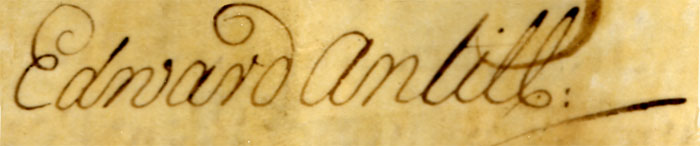
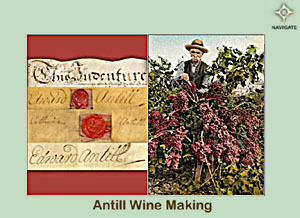
Approx. 80 page paper, well written

Largest individual premium ever
awarded by the Society to an American

Edward Antill
Edward Antill, a New York merchant of the seventeenth century, and his descendents
William Nelson, 1899
Edward Antill, 2d, the son of the New York merchant, by his wife Sarah, was born June 17, 1701.1
There is a pleasant bit of romance about his childhood, in the fact that he was adopted and brought up by Giles Shelley,2
the quondam alleged pirate, who owed his life and liberty to Edward Antill, 1st, as already related.
By will dated Sept. 22, 1708, proved March 6, 1710-11, Shelley gave top his loving friends, Robert Watts and Robert Livingston, merchants, all his
messuage, farm, lands and appurtenances at the Bowery, and the stock, furniture, etc., to hold during the life of Mary Peters, wife of Charles Peters,
in trust, to let her occupy and use the same; at her decease to be held in trust for Edward Antill, "whom I adopted and bread up having no
children of my own;" he also gives Mary Peters three Indian slaves; to "loving Aunt Elizabeth Clark of Gravesend in the county of Kent, England,"
£20 sterling a year during her life; bequest to John Tudor, jun.;3
to wife, "twenty shillings and no more." "To said child Edward Antill my two houses and lands in the city of New York and all other my lands and
tenements to him and the heirs of his body." For want of such heirs, to loving friends Nathaniel Lane and John Lane, both of Barbadoes, merchants, in fee.
Witnesses - A.D. Peyster, Benja. Aske, M. Bickley, James Davis. In a codicil, dated Feb. 19, 1710, it is stated that Mary Peters is dead since the
will was made. By this codicil the testaor gives to "Loving wife" £150 per annum during life; to aunt Elizabeth Clark, £20 more a year;
to friend William Chambers, £50; to widow Shepherd, £50; to Anne Antill, daughter of Edward Antill, L150;
to "loving wife," £60 in money or household goods. Witnesses - Lancaster Symes, Stepn
When Edward arrived at the age of twenty-one years, Robert Watts, one of his trustees and guardians, then a merchant of the Island of Barbadoes,
in the West Indies, delivered to the young man a true and full account of his estate, and paid him L126, 2s. 9 3/4d., the balance due him,
whereupon Antill gave him a discharge, dated August 10, 1723, in which this interesting story of a stranger's generosity, and of a faithful trustee,
is fully set forth.4
Among the property which thus came to young Antill was a mortgage given Feb. 9, 1699-1700, by Michael Hawden, of the city of New York, to Giles Shelly, of the same
city, on "a tract of land on the North Branch of the Raritan river (adjoining John Dalrimple), containing 912 acres English measure;
also 300 acres of upland at Barnegate, beginning at the north of Manahohaky creek, by the Bay, to secure the payment of £330 of Sevill monies
or Pillar pieces of eight each of seventeen penny weight, on Feb. 9, 1700"; none of the money was paid, and when Antill became of age Shelly's executors
assigned the mortgage to him, as residuary legatee of said Shelly;5
Antill assigned the same to Samuel Bayard, Oct. 21, 1732.6

Edward Antill, 2d, took up his residence at an early date at Piscataway Landing, on the Raritan river, on a portion of the broad acres inherited
from his father, and there he spent most of his life. He added a tract, 90x11 chains, on April 7, 1735, by deed from Andrew Johnston, of Perth Amboy,
merchant. In the deed he is described as of Piscataway, and the land as
"in Piscataway on the Raritan river."7
He married Catharine -, as appears from a power of attorney given by Edward Antill, of Piscataway, merchant, appointing Catharine his wife attorney
to enter into his lands, etc., the four houses within the city of New York only excepted, and to convey the same. This
instrument is dated June 20, 1729.8
His first wife having died, he married 2d, Anne Morris, daughter of Governor Lewis Morris, of New Jersey, June 10, 1739; she was
born April 3, 1706.9
She survived him.
Mrs. Antill seems to have possessed something of the Governor's whimsical obstinacy and petulance. Mr. Whitehead says Antill was "an oddity,"
and as an instance thereof relates an incident to the effect that he once expressed to his wife his regret that the women of the day spent so
much time in idleness or profitless pursuits, instead of "abiding in the fields with their maidens," gathering flax or grain. The next
morning on coming down to breakfast Mr. Antill found the house deserted, and no signs of the matutinal repast. His wife had taken him at his word,
and was out in the fields with her handmaidens, pulling flax.10
This is an illustration of the serious view Mr. Antill took of life.
He was elected to the Provincial Assembly in 1738, serving two years, and quite naturally voted in that body to sustain Gov. Morris, his father-in-law, who
on the recommendation of the Council, appointed him, December 1, 1739, to be one of the Judges of the Middlesex
County Court of Common Pleas.11
He was destined for still higher honors. Gov. Morris recommended him in 1740 for a seat in the Council, saying:
"He is a man of good Estate & Sence, and if admitted to that board, I hope and believe will prove an usefull and deserving member of it."
He wss appointed May 25, 1741, to make a quorum of the Council, but appears to have been so indifferent to the honor that he did not
take his seat until October 28, 1743. The appointment was confirmed in 1745.12
He was reappointed in 1746, as a member of Gov. Jonathan Belcher's Council, and again in 1761, in the Council of Gov. Josiah Hardy,
but was suspended by Gov. Thomas Boone a few weeks later, for non-attendance, by which suspension was confirmed by the King in Council, by order
dated January 2, 1762.13
As a member of the Peace of Monmouth county, Dec. 17, 1744; of Bergen county, Sept. 26, 1745, and March 28, 1749; of Middlesex county,
Aug. 16, 1746, and March 28, 1749; of Salem county, March 30, 1749; of Morris county, May 13, 1749; of Cumberland county,
April 25, 1750; and Judge of the Middlesex county Oyer and Terminer, Aug 30, 1746.14
He was not only a merchant, but farmed on an extensive scale, having 370 acres and upwards, 40 being in meadow and timber, and an
orchard of 500 apple trees. He grew apples for his distiller, and raised trees for the market, offering the latter for sale in 1750 at
"nine Pence per Tree, if chosen; or six Pence per Tree if taken by the Row,
as they stand in the nursery."15
His brewhouse, across the river from New Brunswick, was destroyed in a severe storm, in July, 1752, but was at once rebuilt,
60 feet long and 38 feet wide, with a new copper, holding twenty-two barrels, with approved appurtenances for making cider, etc.
He offered the whole place for sale in December, 1752, and again
in September, 1753.16
He advertised in the New York Mercury, March, 1, 1762, for sale "at his Seat near New Brunswick, in New-Jersey, four or five Yoke
of working Cattle, of different Ages, from 8 to three Years old; they are now fit for Service, being in good Heart, and full Flesh'd,
they are fed upon good Hay and Corn."17
The cause of religion and education found in him a valuable supporter. He gave £1,800 in 1754 towards founding King's (now Columbia)
College, in the interest of the Episcopal Church.18
His predilection toward literature was evinced even in his occasional journeys to Trenton, where he put up at the "Sign of Hudibras,"
a famous tavern, in 1761.19
He was one of the warmest friends of Christ Church, New Brunswick, N.J., and in 1759 was one of the trustees of a lottery "for
raising 1500 Pieces of Eight to be applied to the use and finishing" of that church.20
When the Rev. Robert McKean, missionary at New Brunswick, removed in 1763 to Perth Amboy, he reported to the Society (in England)
for Propagating the Gospel in Foreign Parts, under the date of December 16, 1763,
that "the Honble Edward Anthill, Esq., a
man of most exemplary life, and singular piety, had undertaken to read prayers and a sermon every two Sundays at Brunswick, and
every other two at Piscataqua, till the arrival of a missionary," and the Society "Agreed that thanks should be returned to
Mr Parker and Mr Anthill
for their pious labours."21
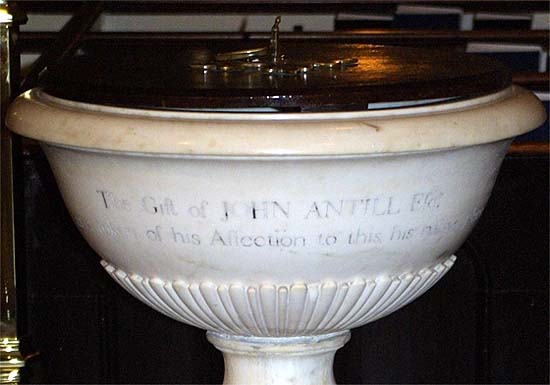
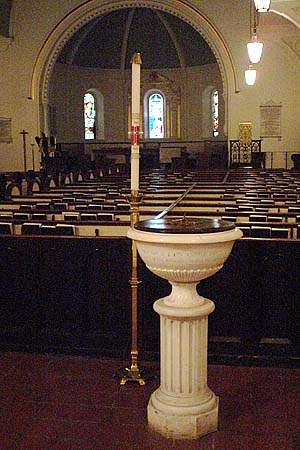
There is a large and handsome marble font in the [New Brunswick] church, on which is inscribed: 'The gift of John Antill, Esq., as a token
of his affection to his native place.' The tradition in the family, however, was that this font was presented by his father, the Hon.
Edward Antill, as a votive offering, in consequence of deliverance from imminent dangers."22
In his will, dated October 25, 1768, he describes himself as "late of Piscataqua but now of Shrewsbury." He names his wife, Anna, sons
Edward (the eldest, to whom he had advanced £300), John and Lewis, and daughters Mary (wife of Richard Cochran),
Sarah and Isabella. He appoints his wife Anne and son Lewis in the executorship, and speaks of his "beloved wife and six
virtuous children." The will was proved August 24, 1770.23
Mr. Antill died August 15, 1770, and was buried near the southeast corner of Christ Church,
New Brunswick.24
In the records of the church is the simple entry: "The Honble Edward Antill Esqr
was interred in X Ch. Yard in N.B. Aug 16, 70."
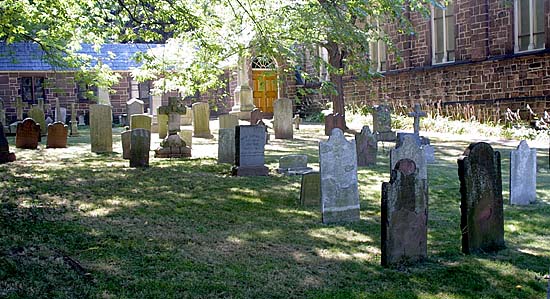
Graveyard; no marker found
In the minutes of the Council of Safety, of New Jersey, met at Princeton, Dec. 12, 1777, we read: "That a flag of Truce from New York
had just arrived in Shrewsbury River, for the families, servants & Effects of Mrs. Antill" and four others.
It was agreed to permit her and the others to pass to New York
with their families, etc.25
This probably refers to Anne Antill, widow of Edward Antill, 2d, for the will of Anne Antill, "at present of the city of
New York, of sound mind but old and infirm," is dated March 27, 1778. It was proved November 20, 1781. She gives to her son
Edward land in Bergen county "left me by the last will of John Corbet Esq." Certain money "in the hands of Charles Lowndes Esq given me by
the will of my dearest sister Euphamia Norris," is to be divided equally between:
1. grandson, John Collins Antill, son of John Antill, Esq.; 2. granddaughter, Isabella Graham Antill, daughter of my son Edward Antill, Esq.;
3. granddaughter, Ann Cochran, daughter of Richard Cochran, Esq.; 4. granddaughter, Elizabeth Colden Antill, daughter
of son, Lewis Antill, deceased. Executor - son, John Antill, Esq. Witnesses - Thomas Davies, Anne Morris, Thos. Skinner (Baker).
John Antill qualified as executor, Dec. 3, 1781.26
1 Antill Family Record.
2 "Giles Shelley(godfather of Edward Antill) was born July ye 30th, 1664." - Antill Family Record.
In the marrriage records of the Dutch Church, in New York, we find the entry; "Giles Schelley, j. m., Van London, en Hillegond Van Hooren,
Wede
Van Olivier Cranisborough, beijde wonende alhier, Nov. 25, 1689." That is: Giles Shelley, bachelor, from London, married
Hillegond van Hooren, widow of Oliver Cranisborough, both living here, Nov. 25, 1689.
3 N.Y. County Wills, Liber No. 8, f.8.
4 N.Y. County Wills, Liber No. 31, f.341.
5 The will of Hillegont Shilley, late of the City of New York, widow (of Giles Shelly), bearing
date May 28, 1:16, witnessed by John Okie, Yacobus Oukie and Leenart Smack, was proved Sept. 29, 1718, before John Barclay, surrogate, authorized
and appointed to take the probate of wills, etc. She devises her whole estate to her executors in trust, to deliver the same to
"my loving sister Mary Vreeland during her natural life," with remainder to the children of said Mary Vreeland then living; if none,
"then to be divided equally between my brothers and sisters: John Van Horn, Garret Van Horn, Abraham Van Horn, Effie Theobalds,
Vroutie Sandford and Janitie Lane, share and share alike." Executors - loving brothers Garret Van Horn and Enoch Vreeland. - E.J. Wills, Liber A, f. 1111.
6 E.J. Deeds, K Large, f. 325.
7 E.J. Deeds, Liber C, f. 242.
8 E.J. Deeds, Liber K Large, f. 102.
9 Antill Family Record.
10 Whitehead's Perth Amboy, 227.
11 N.J. Archives, XV., 99.
12 N.J. Archives, VI., 110, 233, 237; Papers of Lewis Morris, 33, 37, 122,
219, 220, 283.
13 N.J. Archives, VII., 6; IX, 2742, 300, 335; XVII., 238.
14 Liber AAA of Commissions, passim. in Secretary of State's office, Trenton.
15 N.J. Archives, XII., 618, 682.
16 Ib.,, XIX., 168, 208, 292.
17 N.J. Archives, XII., 618, 682.
18 Hist. of N.Y. during the Revolution, by Thomas Jones, I., 10.
19 N.J. Archives, XX., 620.
20 Ibid., XX., 302.
21 MS, Letter from the Society.
22 Record of Christ Church, New Brunswick, N.J., by the Rev. Alfred Stubbs, Rector, 1856, p.26.
23 E.J. Wills, K, 238.
24 Record of Christ Church, 26.
25 Minutes of the Council of Safety, 173.
26 N.Y. County Wills, Liber No. 34, f. 423.
Back To Top
[First Settlers of Ye Plantations of Piscataway and Woodsridge Olde East New Jersey part 3]
(N. E. HIST. GEN. REG., Vol. XIX, (p. 165), (1865), items taken from "Antill Family Records."
Giles Shelley (Godfather of Edward Antill, Jr., whose birth recorded in the next paragraph. S.) was born
July ye 30th 1664.
Edward Antill (son of Edward Antill formerly of Richmond in the County of Surry in Old England,
merchant, but late of New York, in America, attorney at Law, and Sarah his wife) was born in New York
the 17th of June, 1701.
[Whitehead]
Mrs. Antill seems to have possessed something of the Governor's whimsical obstinacy and petulance.
Mr. Whitehead says Antill was "an oddity," and as an instance thereof relates an incident to the effect that he once expressed to his wife his regret that the women of the day spent so much time in idleness or profitless pursuits, instead of "abiding in the fields with their maidents," gathering flax or grain. The next morning on coming down to breakfast Mr. Antill found the house deserted, and no signs of the matutinal repast. His wife had taken him at his word, and was out in the fields with her handmaidents, pulling flax. This is an illustration of the serious view Mr. Antill took of life.
[American Philosophical Society]
Member of both the American Society and the American Philosophical Society at the time of their union in 1769,
and resident member of the American Philosophical Society.

[Architectural History of New Brunswick NJ, 1681-1900]
Antill House,, River Road, Piscataway. 1741; destroyed.
The Antill house is the only major Georgian structure in this area to retain the design of the Dutch colonial
farmhouse. Thus the Antill house is much wider than it is deep; but this width is part of the original plan rather than the result of the addition
of rooms at the side, as was the common practice in the first Dutch Colonial homes in Bergen county. Despite the portico added
on in the Greek Revival period, one can still see the flare of the gambrel roof. This was another Dutch colonial feature; the Antill
house was the only mansion to include it.
While the structure's external appears part of the local Dutch tradition, the interior indicates the influence
of the Georgian style. There are two rooms on each side of a classical hallway, and the common classical motifs are used on walls and mantels.


[Architectural History of New Brunswick NJ
Barbara Cyviner Listokin]
ANTILL HOUSE or ROSS HALL (Figs. 64, 65, 66 and 67)
River Road, Piscataway
1739
DESTROYED 1954
Antill House was the only major Georgian home in the New Brunswick area to retain aspects of the Dutch-Flemish-colonial
farmhouse. Like the Zabriski-Von Steuben House in North Hackensack, Antill House was much wider than it was
deep (56 feet by 35 feet). Both houses had flared eaves at the base
of their gambrel roofs. Both these features are indicative of the Dutch-Flemish colonial tradition. The
Antill House differed from other Dutch farmhouses in that its width was original with the construction of
the home and its interior arrangement followed the Georgian manner.
The foundations of the house were stone, the exterior walls were brick which was then stuccoed over. The portico
on the front was added in the Greek Revival period and was particularly interesting for its adaptation to a sloped
site. The portico was raised, with six Doric columns over six truncated Doric pilasters that were attached
to a rusticated basement. The portico repeated the horizontal emphasis of the original structure but hid the flared
eaves of the roof. The interior had the typical Georgian arrangement, with four rooms coming off a center hallway.
However, in the Antill House, teh front rooms were much larger than the back rooms and were much wider than they were
long. Interior walls were plastered throughout; this indicates a later renovation.
[New Brunswick in History, William H. Benedict]
p.45
In 1742 a movement to build in New Brunswick was under way and a deed from Philip French to a lot on which
the building was going up, dated Dec. 4, 1745, speaks of the building as "in great forwardness." This deed was
to Peter Kemble, Francis Costigan, James Lyne and John Kearney, and was for a lot 150 ft. square. This church
had a lottery in 1758 and obtained a charter in 1759. Its first permanent rector was Rev. William Wood, 1747.
Its lottery was managed by Edward Antill, Bernardus Lagrange, Wm. Mercer, M.D., John Berrian, Samuel Kemble,
William harrison and Peter Kemble.
p.46
A second lottery to complete the church, Dec. 4, 1758, ten years later, drawing on July 17, 1759, brings us
a new set of names - Edward Antill, Bernardus Legrange, William Mercer, Samuel Kemble, William Harrison, Francis
Brasier. Edward Antill is probably one of the best-known men connected with Christ Church, and is
referred to elsewhere.
p.91
When New Jersey was called on to assist in protecting our border from the French and Indians, who had become an
alarming menace, Gov. John Hamilton, on the recommendation of his Council, Robert H. Morris, Edward Antill, James Hude and
John Coxe, appointed and commissioned Col. Peter Schuyler to command the Regiment of Troops, the first ever raised for
service outside of the State in other Colonies, excepting troops sent to the West Indies in 1739-'40.
p.115
Edward Antill, who built Ross Hall, had one son in each army. Stephen Kemble in his "Diary" says: 'Saw his old
schoolmate, Antill, among the prisoners.' He was on one of the prison ships. John and Lewis Antill married Margaret and
Alice Colden, the same family with which Dr. Farquhar and Dr. Auchmuty were connected. Mrs. Antill, her child and her sister,
Miss Colden, obtained permission from the Continental Congress in Philadelphia to proceed from New Brunswick
to New York, after taking an oath to carry no information to the enemy.
[Raritan Millstone Heritage Alliance]
Following his battlefield success in late June of 1778 near
Freehold Court House in the Battle of Monmouth,
Washington and the Continental Army returned to New
Brunswick to give the troops rest and relaxation near
the waters of the Raritan River; but also to mark the
now important holiday of the Fourth of July.
Washington, in this visit, stayed with his staff at the
commodious (and elegant) home of the widow Sarah
Ross, wife of a medical doctor who had died three years
previously, situated in a 350-acre farm estate on the
Raritan River in Piscataway, not far from the road to
New Market.
The house was built in 1739 by Edward Antill, an
importer and gentleman farmer, who was married to
Anne Morris, the daughter of Lewis Morris, royal
governor of New Jersey and lord of the manors of
Morrisana and Tintern (in New York and New Jersey,
respectively), and one of the wealthiest men in the
colonies. The Antill house was a sister structure to the
White house, built the same year by Anthony White,
also a son-in-law of Lewis Morris, married to Morris’
daughter Elizabeth.
The White house (called Buccleuch by a later owner) still
stands in New Brunswick’s Buccleuch Park. The Antill
house, called Ross Hall by Dr. Ross and his wife, burned
down about 40 years ago, its location today marked only
by a street name, Ross Hall Boulevard.
Part of the house, however, was saved: an
elaborate paneled fireplace wall, with side cabinets, for
which no comparable structure exists at Buccleuch
Mansion. Rutgers history professor Richard P.
McCormick and other university historians, managed to
salvage the wall; and presented it to the New Jersey
Historical Society for display at its museum in Newark.
[Ross Hall, Entwined with Buccleuch, Now Centre of Extensive Development
May 24, 1925, The Sunday Times, New Brunswick NJ]
...Ross Hall has a story which goes back to the days before the Revolution, during which conflict it witnessed many
stirring scenes. At the height of its glory, it had a knee-trousered, brass-buttoned, fox-hunting owner who lived the life of
an English gentleman, driving in a "coach and four" and entertaining the entry for miles around. ...
One goes back then to the time when in 1739 the two doubtless beautiful daughters of Governor Lewis Morris
of the Province of New Jerrsey married two young men of the first families of the vicinity. Elizabeth
married Colonel Anthony White and went to live in a new house on the brow of the hill overlooking the bright waters of
the Raritan, later to be known as Buccleuch. Anne went as a bridge
to the house of Edward Antill almost directly across the river, a home as imposing as that over which her sister presided.
At this time the present Buccleuch was known simply as the White House after its owner. These were pleasant
times but mostly uneventful, nearly thirty years before the Revolution. The lives of the White and Antills in the
rambling, pretentious houses on opposite of the Raritan.
These two families lived the lives of leisurely gentleman farmers, riding about in their coaches and entertaining folk
from roundabout and the distant "towns" of New York and Philadelphia. ...
it is recorded that Anne Morris wedded Edward Antill on June 10, 1789. Antill had built or had immediately
proceeded to build a house on the three hundred and fifty acre tract shortly before
acquired by his father across the river from the present city of New Brunswicks. ...
Records of the Antill family apparently were more carefully kept thatn were those of the Whites, for it is known that the first child of the Antill union
was born in the Antill house - Ross Hall - in 1740.
[Merchants and Gentlemen at Raritan Landing]
EDWARD ANTILL, ESQ.
FROM MY HOUSE on the Road Up Raritan, Raritan Landing looked like New Amsterdam. That's what I called it when I advertised the property for sale in 1753. I had 370 acres, much of it in meadow, but there were also 70 acres of good woodland and 10 acres of orchard in its prime together with a large collection of the best fruit trees: apricots, nectarines, peaches, plums, pears, hard and soft-shell almonds, early apples and English cherries. I even had a vineyard of about 600 vines for which I received £200 sterling from the Society for Promoting Arts and Agriculture. I was mainly what you would call a gentleman farmer—after all I was married to Anne Morris, the governor's daughter, and needed to stay above the fray—but we did some brewing on the property. My brewhouse was 60 feet long and 38 feet wide with a new boiler, called a copper, and 22 barrels that were connected to a system for carrying the liquor directly from place to place. My main income came from importing. Unlike the small-time traders in the village, I ordered linens directly from London; John Watts of New York conveyed my orders to Bristol. With other members of my class, I was a charter member of the Church of England in New Brunswick, which finally opened in 1761. I served as a vestryman and am buried in the churchyard.
[Historic American Buildings Survey of New Jersey
William B. Bassett, New Jersey Historical Society, 1977]
Antill, Edward, House ("Ross Hall") (NJ-362),
NE. corner River Rd. and Ross Hall Blvd. Brick (Flemish bond), stucco, and fieldstone, 56'-4" (five-bay front)
x 39'-7", one-and-a-half stories on slope with raised fieldstone basement, gambrel roof, pent
roofs, and full-length porch. Built 1740, demolished c. 1958. Occupied from 1740 to 1763 by Edward Antill and
his wife Anna, a daughter of the Colonial Governor of New Jersey, Lewis Morris; Dr. Alexander Ross occupied the house after
the Antills until 1775. Parlor paneling in the museum of New Jersey Historical Society, Newark, NJ,
17 sheets (1937, including plans, elevations, details;) 1 ext. photo (1936), 2 int. photos including
cupboard detail (1936); 2 data pages (1937).
[Abstracts of Wills Vol X 1780-1782]
Page 342.--In the name of God, Amen. I, ANN ANTILL, at present of the City of New York, in
North America, being of sound mind but old and infirm, etc. I leave to my son Edward my
lands in the County of Bergen, in the Province of New Jersey, left to me by the last Will of
John Corbett, Esq. I desire that my money in the hands of Charles Lowndes, Esq., given to me
by the Will of my deceased sister, Euphamia Norris, be divided into five equal parts and
disposed of as follows, viz.: to my grandson, John Collins Antill, son of John Antill, Esq.; to my
granddaughter, Isabella Graham Antill, daughter of my son, Edward Antill, Esq.; to my
granddaughter, Ann Cochran, daughter of Richard Cochran, Esq.; to my granddaughter,
Sarah Morris, daughter of Lieut. Colonel John Morris; and to my granddaughter, Elizabeth
Colden Antill, daughter of my son, Lewis Antill, deceased. As to the money given to me by my
late beloved husband, Edward Antill, Esq., and any other money I may die possessed of, I
desire it may be equally divided among my children. I make my son, John Antill, Esquire, my
sole executor.
Dated March 27, 1778. Witnesses, Thomas Davies, Ann Morris, Thos. Skinner, baker. Proved,
November 20, 1781.
NOTE.--On December 3, 1781, John Antill, Esq., appeared before the Surrogate for the City
and Province of New York, and was duly sworn to the true execution and performance of said
Will.
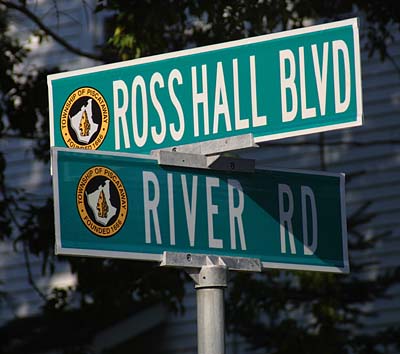
Corner where Ross Hall, the Antill mansion, once stood
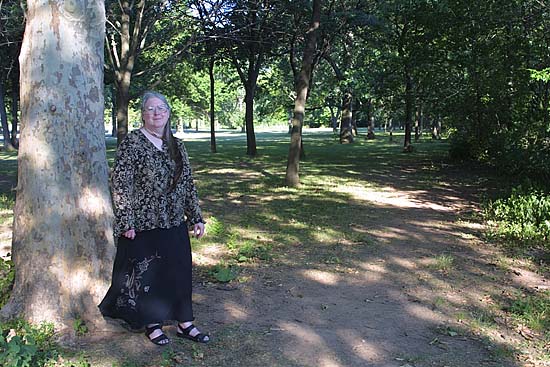
Mary in park that was once the Raritan River estate of Edward and Anne Antill
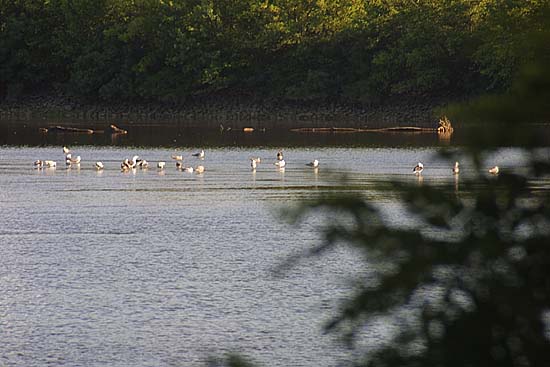
Raritan River from park that had been the Antill estate
|
Proceedings of the NJ Historical Society, 1909
Now for a brief account of some of our oldest hourses: Ross Hall and the White House, or Buccleugh,
were built about the same time, and for the housing of two sisters - Governor's daughters - and
just opposite on the two banks of the river.
ROSS HALL AND ITS VARIOUS OWNERS.
Edward Antill, born in 1659, and who at twenty-seven years of age married Elizabeth Bowne, September 10, 1686,
and whose second wife was named Sarah, had six children; three - William, Charles and Annie - assigned to his
first wife, and three - Edward, Elizabeth and George - to the second wife. His will, made in 1704,
mentions wife Sarah and six children; and was proved in 1725. Antil bought a one-quarter interest
of one of the twenty-four Proprietors of East Jersey, James, Earth of Perth. He also bought one of the twelve
Raritan lots, No. 11, of Thomas Matthews, December 20, 1686; and in 1688 he acquired as a proprietor the
tract we know as Ross Hall. But he never seems to have made his home here.
His son, Edward Antill, 2d, born June 17, 1701, married as his first wife Catherine -, had no children.
He married second, Anne, daughter of Gov. Lewis Morris, June 10, 1739. She was then thirty-three, having been
born in 1706, and was sister of Elizabeth Morris White, living directly across the river opposite at the White
House, later Buccleugh.
Antill now decided to settle on the tract his father acquired fifty years before, and built a house at Piscataway Landing. (The
Landing seems to have been anywhere from the Albany street bridge to the Landing bridge, and on either side of the river.)
He describes it as land inheirted of his father, a farm of 370 acres, a mile from New Brunswick, and comprising an easy
well-built farm house and brew house. That he built just before immediately after his marriage in 1739 is evident, as his
first child was "born in the house in 1740." The children were Edward 3d, John, Lewis, Mary, Sarah and Isabella. The latter
married Rev. Robert McKean, missionary, the third sent out to New Jersey by the Society of Propagstion of the Gospel of
Foreign Parts in 1757. The first was named Brook, who married a Miss Farmer, and who rode a circuit of fifty miles,
pearching at Elizabethtown, Perth Amboy, Cheesequakes, Freehold, Rocky Hill and Piscataay, and dates from 1704.
The second was the Rev. Wm. Wood, installed in 1747, and the third the Rev. Robert McKean, just mentioned, who died
at Ross Hall, October 27, 1767, less than two years after his marriage. He was followed by the Rev. Abraham Beach, 1767,
of whom it is said that he was the only minister of the Church of England who regularly performed the services of the Church
during the Revolutionary period in the Province, which certainly speaks volumes as to his tact and diplomacy.
But to return to our subject, Edward Antill was Judge of the Middlesex Court of Common Pleas in 1739, member of
Council in 1741 and 1761, and he was still here in 1763. His will, made in 1768, describes himself as "late of
Piscataway, but now of Shrewsbury," so the sale of the place must have been between those dates. In offering the
place for sale he says it is near two good markets, New Brunswick on the one hand and Raritan Landing on the other,
placing them apparently on a par, has fifty acres of low meadow between the house and the river, and in regard to title has
been eighty years in possession. This added to the date his father acquired it, 1688, would bring the date of the sale
to 1768, the date of his will, so that he may have just sold the place and moved to Shrewsbury in 1768.
... (Continues with the history of the next owner, Alexander Ross, Esq., M.D.)
|
New Jersey Archives, Vol. XXV: Newspaper Abstracts 1766-1767 (1903)
p389-392 by Nelson, William (Ed.)
Edward Antill, the son of the New York merchant, was born in 1699 or 1700, and perhaps came
into the possession of the "Laird of Minnevarre's" broad acres at Raritan landing in Middlesex
county, where he spent most of his life.
Mr. Whitehead refers to him as "an oddity," and
relates an incident to the effect that he once regretted to his wife that the women of
the day spent so much time in idleness or profitless pursuits, instead of
"abiding in the fields with their maidens," gathering flax or grain.
The next morning on coming down to breakfast Mr. Antill found the house deserted,
and no signs of the matutinal repast. His wife had taken him at his word, and
was out in the fields with her handmaidens, pulling flax.
This is only an instance of the serious, earnest view Mr. Antill took of life.
In 1754 he gave 1,800 pounds towards founding Columbia College, in the interest of the
Episcopal Church. He was one of the warmest friends of Christ Church, at New Brunswick,
and in 1769 was one of the trustees of a lottery for the benefit of that church.
When the Rev. Robert McKean, missionary at New Brunswick,
removed in 1703
to Perth Amboy, he reported to the Society (in England) for Propagating the Gospel in Foreign Parts,
that "the Hon Edward Antill, Esq., a man of most exemplary life, and singular piety,
has undertaken to read prayers and a sermon every two Sundays at Brunswick, and every
other two at Piscataqua, till the arrival of a missionary," and the Society voted him their
thanks "for his pious labors."

Christ Church
He was a member of the General Assembly which met at Perth Amboy, October 27, 1738,
in which body he voted to sustain Governor Lewis Morris
[his father-in-law], who was not unnaturally recommended him in 1740 for a seat in the Council.
"He is a man of good Estate & Sence, and if admitted to that board, I hope and believe will
prove an usefull and deserving member of it." He was appointed May 29, 1741, to make a
quorum of the Council, and the appointment was confirmed in 1745.
He was reappointed in 1746, as a member of Governor Belcher's Council.
"Mr. Antill died August 15, 1770, in the 71st year of his age, and was buried
near the southeast corner of Christ Church, New Brunswick.
Graveyard; no marker found
There is a large and handsome
marble font in the church, on which is inscribed: 'The gift of John Antill, Esq., as a
token of his affection to his native place.' The tradition in the family, however, was,
that this font was presented by his father, the Hon. Edward Antill, as a votive offering,
in consequence of deliverance from imminent danger."
Mr. Antill left three sons - Edward,
John and Lewis.
The latter two, with Margaret Antill and others, had a survey of 20,000 acres returned to them
in 1770 by New York, of lands subsequently declared to be in Vermont, and in 1774
John secured 3,000 acres in western New York, which he sold in 1776 to Robert L. Hooper,
perhaps to avoid confiscation.
Lewis is said to have served in the American army during the Revolution, and
lost his life at Brandywine.
Was he not the Dr. Lewis Antle who visited Judge John Fell when the latter was a prisoner
of the British in New York in 1777?
|
Descendants of Edward Antill
	1  	Edward Antill	b: 17 Jun 1701 in Piscatauqua, New Jersey  adopted son Cap Giles Shelley
  d: 15 Aug 1770 in b: near se corner of Christ Church, New Brunswick
..		+Catharine
		*2nd Wife of Edward Antill:
..		+Anne Morris	b: 03 Apr 1706 in Morrisania, Bronx, NY	d: Nov 1781 in will March 27, 1778;
	2  	Sarah Amille Antill	b: 18 Aug 1740 in Piscatauqua, Middlesex, New Jersey  7pm
....		+Lt. Col. John Morris	b: in Shrewsbury, Monmouth, NJ
...	3  	Amelia Morris	b: Abt. 1775
...	3  	Sarah "Sally" Morris	b: Abt. 1774
.......		+Drake Ludlow
...	3  	John Morris	b: Abt. 1772
	2  	Colonel Edward Antill	b: 11 Apr 1742 in Piscataqua, N. J.
                            d: 21 May 1789 in St. John's, near Montreal, Canada
....		+Marie-Charlotte Riverin	b: 29 May 1750 in Quebec	d: 03 Sep 1785 in New York
...	3  	Isabella Graham Antill	b: 04 May 1767 in Montreal
.......		+William Hall	b: in of Staffordshire, England
.....	4  	William Hall, Jr.	b: 10 Sep 1788	d: 07 Apr 1850
.........		+Charlotte Loedel	b: 09 Nov 1788	d: 20 Aug 1841
........	5  	Henry Edward Hall	b: 01 Jul 1815
........	5  	Margaret Hall	b: 19 Mar 1817	d: Feb 1897
........	5  	Charlotte Hall	b: 10 Jul 1819	d: 04 May 1877
............		+Randolph Routh	b: 16 Apr 1820	d: 07 Apr 1897
........	5  	Caroline Wilheimina Hall	b: 11 Mar 1821	d: 10 May 1843
........	5  	Frances Henrietta Hall	b: 19 Jul 1825	d: 27 Feb 1890
.....	4  	Unknown Hall
.........		+David Stansfield
........	5  	Charlotte Stansfield
........	5  	Jane Stansfield	b: 14 May 1816	d: 21 Mar 1892
............		+Unknown Francis
........	5  	Margaret Stansfield
........	5  	Georgiana Stansfield
........	5  	George Stansfield
...	3  	Charlotte Antill	b: 02 Sep 1769 in Montreal	d: 08 Oct 1769
...	3  	Mary Antill	b: 18 Jan 1771 in Montreal	d: 24 Aug 1834 in Utica
.......		+Colonel Gerrit G. Lansing	b: 11 Dec 1760 in Albany
                                      d: 27 May 1831 in Oriskany
.....	4  	Barent Bleecker Lansing	b: 17 Jan 1793 in Argyle, Washington  NY
                                  d: 03 Dec 1853 in Brooklyn buried Utica
.........		+Sarah Breese	b: 06 Dec 1795 in Saybrook CT	d: 16 Jun 1879 in Whitestown
........	5  	Brig. Gen. Henry Livingston Lansing	b: 15 Jan 1818 in Rome, New York
                                        d: 30 Sep 1889 in Canandaigua
............		+Catharine Olivia Gibson	b: 26 Feb 1818 in NYC	d: 25 Oct 1897 in Canandaigua
........	5  	Manette Antill Lansing	b: 17 Feb 1820 in Utica 	d: 05 Nov 1888
............		+Charles Walker Morse	b: 17 Mar 1823 in Saybrook CT
                                      d: 16 Apr 1887 in Old Saybrook, CT
........	5  	Captain Arthur Breese Lansing	b: 04 Aug 1815 in Utica NY	d: 09 Feb 1880 in NYC
............		+Louise Cochran Lovett
........		*2nd Wife of Captain Arthur Breese Lansing:
............		+Janet Suffern	b: 12 Jun 1825 in of NYC	d: 13 Oct 1904
........	5  	General Henry Seymour Lansing	b: 17 Feb 1823 of Phil.
                                            d: 14 Apr 1882 in Burlington NJ
............		+Jane Amelia White	b: 02 Sep 1825 in Onondaga, New York
                                    d: 29 Nov 1904 in Trenton, NJ
........	5  	Barent Bleeker Lansing	b: 1837  d: 03 Oct 1887 in Utica NY
............		+Sophie E. Williams	b: 1836 of Buffalo	d: 23 Mar 1901 in Buffalo NY
.....	4  	Judge Richard Ray Lansing	b: 07 Jul 1789 in Albany NY 	d: 29 Sep 1855 in Detroit
.........		+Elizabeth Davenport Livingston	b: 17 Mar 1805 in Poughkeepsie NY
                                            d: 21 Mar 1886 in Michigan
.....		*2nd Wife of Judge Richard Ray Lansing:
.........		+Susanna Platt	b: 27 Nov 1793 in Whitesboro NY	d: 14 Dec 1843 in Bristol Indiana
........	5  	Edward Antill Lansing	b: May 1814 in Jul 1814  d: 12 Jun 1868 in Detroit
............		+Mary	b: Abt. 1819	d: 14 Dec 1843 in Bristol Indiana
........		*2nd Wife of Edward Antill Lansing:
............		+Ann Christina DeQuindre
........	5  	Jonas Platt Lansing	b: 01 Jan 1816 in ch: 17 Feb 1820 Utica NY
                                  d: 03 Jul 1843 in Sisal, Yucatan
........	5  	Manette Lansing	b: 12 Dec 1817 in Utica NY	d: 03 Sep 1904
............		+Bayard Boyd	b: 10 Jan 1815	d: 26 Aug 1875
........	5  	Gerrit G. Lansing	b: 11 Jun 1820 in NY	d: 13 Oct 1852
............		+Mary Rebecca Judson	b: 05 May 1824 in Missouri
........	5  	Helen Platt Lansing	b: 28 Mar 1822	d: 10 Nov 1860 in Detroit
............		+Judge Sylvester Larned	b: 23 Sep 1820 in of Detroit	d: 25 Nov 1893
........	5  	Charlotte Mills Lansing	b: 19 Sep 1826	d: 08 Jul 1892 in Albany NY
............		+Elias Willard Smith	b: 04 Oct 1816	d: 24 May 1886
........	5  	Richard Lansing	b: 29 Apr 1824	d: 11 Jan 1826
........	5  	Frances Tappan Lansing	b: 06 Dec 1830	d: 28 Nov 1841
........	5  	Cornelia Platt Lansing	b: 26 Sep 1832	d: 29 Nov 1841
........	5  	Melancthon Woolsey Lansing	b: 28 Sep 1834 in Utica	d: Bef. 1868
............		+Mary Jane Abbott	b: 06 Jul 1837
........	5  	Phillipina S. Lansing	b: 27 Aug 1836	d: 07 Aug 1886
........	5  	Susan L. Lansing	b: 20 Mar 1839
............		+Selah Vanduzer Reeve	b: 1835	d: 1904
........	5  	Richard Lansing	b: 28 Oct 1828	d: 19 May 1831
.....	4  	Edward Antill Lansing	b: 10 Jul 1797 in Saratoga NY
.....	4  	Charlotte H. Lansing	b: Abt. 1797 in Schaghticoke
.........		+Reverend Samuel Thomas Mills	b: in Litchfield Twp, New York
........	5  	Unknown Mills	b: Abt. 1815 in Litchfield Twp, Herkimer, New York
........	5  	Unknown Mills	b: Abt. 1817 in Onondaga, Onondaga, New York
........	5  	Samuel Mills	b: 08 Nov 1818 in Utica New York
........	5  	Arthur Tappan Mills	b: Abt. 1822 in Moscow New York
........	5  	John Mills	b: Abt. 1824 in Moscow New York
........	5  	Minette Mills	b: Abt. 1826 in Smithfield New York
........	5  	Elizabeth Mills	b: Abt. 1829 in Smithfield New York
...	3  	Julia Antill	b: 28 Mar 1772 in Montreal	d: 19 Dec 1787 in Quebec
...	3  	Edward Antill	b: 04 May 1775 in Montreal	d: 1776 in Montreal
...	3  	Amelia Antill	b: 15 May 1777 in Lancaster, Pennsylvania	d: Dec 1777
...	3  	John Antill	b: 15 Dec 1779 in Flatbush, Long Island	d: Oct 1781
...	3  	Henrietta Antill	b: 12 Sep 1780 in Bushwick, Long Island
.......		+Dr. Charles Blake		d: 1810
.....	4  	Anna Blake
.....	4  	Edward Blake
.....	4  	John Blake
.....	4  	Antill Blake
...		*2nd Husband of Henrietta Antill:
.......		+Bernard A. Panet
.....	4  	Henrietta Panet	b: 1823
.........		+Capt. George B. Shakespear
........	5  	Harriet Blanche Shakespear	b: 15 Jun 1846
............		+Maj. Gen. J. E. Mayne
........	5  	Rosaline Louisa Shakespear	b: 13 Jul 1847
............		+Surg. Gen. W. Sim Murry
........	5  	Amy Sophia Shakespear	b: 08 Oct 1848
............		+Maj. Brydges Robinson Bramfill
........	5  	Lt. Col. Arthur Bucknall Shakespear	b: 14 Dec 1849
............		+Edith D. O. Atkinson
........	5  	Capt. William Powlett Shakespear	b: 18 Jun 1851
............		+Amy Isabel Booker
........	5  	Louisa Arabella Shakespear	b: 12 Sep 1852
............		+Col. William Randolph Routh	b: 30 Nov 1849
........	5  	Caroline Isabella Shakespear	b: 17 Nov 1856
............		+Col. John Younger
........	5  	Grace Alice Shakespear	b: 18 Mar 1858
............		+Col. Thomas Viret Shepherd
........	5  	John Young Shakespear	b: 02 Jun 1859	d: 01 Mar 1879
............		+M. Shuttleworth
........	5  	Noel George Shakespear	b: 11 May 1862
............		+Dora Shakespear
........	5  	Edward Bucknell Shakespear	b: 17 May 1864
............		+Margaret Georgiana Mulliken
........	5  	Mary Maud Shakespear
............		+Capt. Daniel Fitzgerald Downing
........	5  	Comdr. Hastings Frank Shakespear	b: 27 Mar 1868
............		+Darcy Anderson
...	3  	Louisa Antill	b: 02 Dec 1782 in Colden Ham, Orange County	d: Jun 1783
...	3  	Frances Antill	b: 04 May 1785 in Brookland Heights Long Island NY
                        d: 21 Jul 1863 in New Haven CT
.......		+Arthur Tappan	b: 22 May 1786 in Northampton, Mass	d: 23 Jul 1865
.....	4  	Benjamin Edward Antill Tappan	b: 03 Aug 1813	d: 26 Nov 1862
.........		+Lucy R. Reed	b: in of Boston MA
........	5  	James Reed Tappan	b: 1837	d: Apr 1845
........	5  	Edward Antill Tappan	b: 1839	d: Apr 1845
.....		*2nd Wife of Benjamin Edward Antill Tappan:
.........		+Rachel Bromby Staines	b: 1825 in Brombly?	d: 1899
........	5  	Frances Antill Tappan	b: 05 Sep 1854
............		+James McMahon Fox	b: in of Milwaukee MI
........	5  	Janet Macindoe Tappan	b: 18 Jan 1858 in Mc Indoe
............		+Stephen Strong Gregory	b: in of Madison WI
........	5  	Theodora Antill Tappan	b: 15 Jun 1860
............		+James Reeve Stuart
........	5  	Arthur Tappan	b: 27 Aug 1853	d: 22 Jul 1854
........	5  	Mary Bleecker Lansing Tappan	b: 07 Apr 1856	d: 31 Aug 1859
.....	4  	Katherine Colt Tappan	b: 29 May 1827 in lived Coalburgh W Va
                                d: 15 Aug 1901 in Coalburgh WV
.........		+William Henry Edwards	b: 15 Mar 1822 in Hunter, N. Y.
........	5  	William Seymour Edwards	b: 14 Sep 1856 in NY
........	5  	Edith Katharine Antill Edwards	b: 22 Sep 1852 in London England
............		+Theodore Luqueer Mead
........	5  	Anne Scott Edwards	b: 25 Feb 1858 in NYa
............		+Webster D. Smith
.....	4  	Charlotte Lansing Tappan	b: 04 Feb 1812	d: 22 Jan 1892
.........		+Rev. William Beale Lewis	b: 29 Jul 1812 of Brooklyn NY	d: 27 Dec 1849
........	5  	William Lewis	b: 26 Dec 1835	d: 26 Dec 1835
........	5  	Dr. William Beale Lewis, 2nd	b: 12 May 1842
............		+Rebecca Matilda Edwards
........	5  	Frances Antill Lewis	b: 15 Feb 1837	d: 10 Jul 1901
............		+Alexander J. Walker		d: 25 Jun 1872
........	5  	William Arthur Lewis	b: 22 Feb 1839	d: 05 Nov 1841
........	5  	Theodore Mason Lewis	b: 09 Aug 1843	d: 23 May 1860
........	5  	Charlotte Sophia Lewis	b: 09 Oct 1844	d: 24 Aug 1845
........	5  	Elizabeth Wilson Lewis	b: 28 Oct 1849
............		+Rev. Thornton MacNess Niven, Jr.	b: in of Dobbs Ferry NY
.....	4  	Frances Antill Tappan	b: 20 Dec 1815	d: 05 Sep 1860
.........		+John Forman Seymour	b: 21 Sep 1814 in of Utica NY	d: 22 Feb 1890
........	5  	Frances Antill Seymour	b: 1840	d: 18 Aug 1853
........	5  	Horatio Seymour	b: 06 Jan 1844	d: in resides Marquette WI
............		+Abigail Adams Johnson	b: 23 Nov 1855
........	5  	Mary Ledyard Seymour	b: 11 Sep 1847
............		+Dr. Willis E. Ford	b: in of Utica NY
.....	4  	Sarah Salisbury Tappan	b: 19 Feb 1819	d: 18 Oct 1895
.....	4  	Elizabeth Riverin Tappan	b: 08 Apr 1821	d: 24 Mar 1903
.........		+John Penny Marvin	b: 06 Nov 1819	d: 14 Aug 1849
........	5  	Arthur Tappan Marvin	b: 19 Feb 1846	d: 17 Jul 1902 in resides CA
............		+Mary Barney
........	5  	Charles Steadman Marvin	b: 22 Oct 1848 in 18 MAY 1847	d: 10 Aug 1849
........	5  	Frances Antill Marvin	b: Oct 1848
............		+Rev. Zachery Eddy	b: 19 Dec 1815 in of Detroit MI	d: 15 Nov 1891
.....	4  	Arthur Tappan, Jr.	b: 01 Sep 1825	d: 08 Aug 1826
.....	4  	Maryan Lansing Tappan	b: 24 Oct 1823	d: 06 Jul 1831
...	3  	Euphemia Antill	b: 05 Jul 1773	d: 19 Jul 1773
	2  	Isabel Graham Antill	b: Abt. 1741 in or 1748 Piscataqua, Middlesex, New Jersey
....		+Unknown McNeil
		*2nd Husband of Isabel Graham Antill:
....		+Reverend Robert McKean	b: 13 Jul 1732 in N.S.
                                d: 17 Oct 1767 in Raritan Landing NJ
	2  	Major John Antill	b: 1744 in Piscataqua, Middlesex, NJ	d: 1816 in Canada
....		+Jane Colden
...	3  	Edward Antill
...	3  	Alexander Colden Antill
		*2nd Wife of Major John Antill:
....		+Margaret Colden	b: in of Coldenham, Duchess, NY
...	3  	Major John Collins Antill	b: Abt. 1768 in New Brunswick, NJ	d: Abt. 1837 in Ceylon
.......		+Unknown		d: 1783 in Canada
.....	4  	child1 Antill
.....	4  	child2 Antill
.....	4  	child3 Antill
...	3  	Henry Colden Antill	b: 01 May 1779 in New Brunswick NJ
                            d: 14 Aug 1852 in Jarvisfield, Picton, NSW
.......		+Eliza Wills	b: 10 Sep 1802	d: 30 Sep 1858 in St Leonards. NSW
.....	4  	Henry Colden Antill, Jr.	b: 07 Apr 1826 in 'Jarvisfield', Picton, NSW
                                    d: 17 Mar 1913 in Parramatta
.........		+Teresa Hatch	b: 05 Jan 1835 in Hobart Town	d: 19 Sep 1882 in Queanbeyan
........	5  	Henry Colden Antill III	b: 14 Jun 1854 in Picton, NSW
                                      d: 19 Dec 1932 in Picton,NSW
............		+Jane Anne Brown
........	5  	Alice Eliza Antill	b: 26 Jul 1852 in Picton, NSW
........	5  	Eveline (twin) Antill	b: 16 Jan 1857 in Picton, NSW
........	5  	Mary (twin) Antill	b: 16 Jan 1857 in Picton, NSW
.....	4  	Margaret Campbell Antill	b: 27 Jun 1820 in Sydney, NSW
                                    d: 22 Jul 1849 in Picton, NSW
.....	4  	John Macquarie Antill	b: 31 May 1822 in 'Moorebank',near Liverpool, NSW
                                d: 04 Jun 1900 in Sydney, NSW
.........		+Jessie Hassall Campbell	b: 26 Mar 1834 in Anne's Vale, NSW	d: 07 Feb 1917
........	5  	Major Gen John Macquarie Antill	b: 26 Jan 1866 in Jarvisfield, NSW
                                              d: 01 Mar 1937
............		+Agnes Marion Willsallen
........	5  	Margaret Campbell Antill	b: 04 Jul 1852 in Picton, NSW
........	5  	Jessie Macquarie Antill	b: Abt. 1853 in Picton, NSW
........	5  	Celia Farrington Antill	b: 22 Feb 1855	d: as an infant
........	5  	John Macquarie Antill	b: 09 Jun 1857 in Picton, NSW
........	5  	Robert Henry Antill	b: 31 May 1859 in Picton, NSW
........	5  	Celia Farrington (2) Antill	b: 13 Oct 1861 in Picton, NSW
........	5  	Selina Johnston Antill	b: 09 Oct 1863 in Picton, NSW
........	5  	Captain Edward Augustus Antill	b: 04 Dec 1867 in Picton, NSW
............		+L. M. Christian
........	5  	Guy Forrest Antill	b: 04 Nov 1869 in Picton, NSW
........	5  	Elizabeth Anne Antill	b: 30 Jul 1871 in Picton, NSW
............		+Col. H. B. Lansetter, C. B.
.....	4  	Alice Sophia Antill	b: 27 Mar 1824 in 'Moorebank', near Liverpool,NSW
.........		+Henry Moggridge
........	5  	Major John Antill Moggridge
........	5  	M Moggridge
............		+Lieut. Keppel Foote, R. N.
.....	4  	William Redfern Antill	b: 03 Jan 1828 in 'Jarvisfiled', Picton, NSW
                                  d: 05 Sep 1905
.........		+Mary Susan Bell
........	5  	Amy Mary Antill	b: 1866 in Picton,NSW
........	5  	Estelle Emma Voss Antill	b: 1877 in Picton,NSW
........	5  	Florence Augusta Antill	b: 1873
........	5  	Frances Antill	b: 07 Jul 1863
........	5  	Francis William Antill	b: 07 Jul 1862
........	5  	Georgina E. Antill	b: 13 Nov 1864
........	5  	Grace Isabel Antill	b: 1871
........	5  	Sarah Georgina Antill	b: 1875
........	5  	William Redfern Antill	b: 18 Apr 1879
.....	4  	Thomas Wills Antill	b: 20 Nov 1830 in 'Jarvisfield',Picton,NSW
                              d: 11 May 1865 in Nelson,NZ
.........		+Sarah M. McKee
........	5  	Maria Antill	b: 20 Feb 1852 in Picton,NSW
.....		*2nd Wife of Thomas Wills Antill:
.........		+Isabella Fisher
........	5  	Henry Antill	b: 23 May 1855
........	5  	Fanny Jessie Antill	b: 27 Aug 1857
........	5  	Charlotte Antill	b: 01 Jul 1860
........	5  	Mary Emily Antill	b: 10 Jun 1863
.....	4  	Edward Spencer Antill	b: 20 Jul 1832 in Picton,NSW
.........		+Mary Campbell
.....	4  	James Alexander Antill	b: 07 Nov 1834 in Picton,NSW
                                  d: 15 Feb 1920
.........		+E.C. Poynton
........	5  	Henry Colden Antill	b: Abt. 1858
........	5  	Isabella Jessie Antill
.....		*2nd Wife of James Alexander Antill:
.........		+Susanna Caroline Wild
........	5  	Alick Edward Antill	b: 08 Dec 1877
........	5  	Emmeline Nelly Antill	b: 12 Aug 1874
........	5  	James Alexander Antill
............		+Florence Mary Wauch
........	5  	Loftus Cliff Antill	b: 23 Sep 1876
........	5  	Robert Arthur Antill	b: 26 Aug 1881
........	5  	Ada Antill
........	5  	Alice Eliza Antill
........	5  	Theodora Dora Antill
........	5  	Eileen Antill
........	5  	Loftus Cliff (2) Antill	b: 18 Apr 1879
.....	4  	Selina Antill	b: 17 Oct 1837 in Picton, NSW	d: 01 Dec 1924
.........		+Robert Francis Pockley
........	5  	Robert Fulcher Pockley	b: 24 May 1855
........	5  	Francis Antill Pockley	b: 28 Apr 1857
........	5  	Arthur Bingham Pockley	b: 10 May 1859
........	5  	Alice Isabella Pockley	b: 08 Jun 1861
........	5  	Harold Richardson Pockley	b: 27 Sep 1863
........	5  	Florence Augusta Pockley	b: 02 Jan 1866
........	5  	Ethel Ernestine Pockley	b: 12 Mar 1868
........	5  	Norman Vanderbyl Pockley	b: 23 Nov 1869
........	5  	Kathleen Mabel Pockley	b: 14 Mar 1872
........	5  	Eustice Mitford (twin) Pockley	b: 11 Oct 1873
........	5  	Edith Muriel (twin) Pockley	b: 11 Oct 1873
........	5  	Harold Campbell Pockley	b: 19 Nov 1874
........	5  	Eric Osbaldeston Pockley	b: 19 May 1876
........	5  	Enid Marguerite Pockley	b: 10 May 1879
........	5  	Helen Marjorie Pockley	b: 28 Mar 1882
...	3  	Eliza Hope Antill	b: Abt. 1781 in New Brunswick NJ
.......		+Cadwallader Colden
.....	4  	Thomas Colden
.....	4  	Margaret Colden
.........		+J Trimble
	2  	Dr. Lewis Antill	b: 10 Dec 1746 in Piscataqua NJ	d: 11 Sep 1777 At sea
....		+Alice Colden	b: 22 Feb 1744/45	d: Abt. 1776
...	3  	Elizabeth Colden Antill	b: 09 May 1774 NY	d: 03 Jun 1835
.......		+Rev. Frederick Van Horne	b: Abt. 1768
                                    d: 31 May 1835 in Poughkeepsie, NY
...	3  	Alice Antill	b: 17 Jan 1776	d: 25 Jun 1870
.......		+William Davies	b: 21 Mar 1763 in New Milford, CT	d: 07 Feb 1857
...	3  	Edward Antill	b: 01 Jan 1772
	2  	Mary Antill	b: Abt. 1743 in Piscataqua, Middlesex, New Jersey
....		+Richard Cochran	b: 1739 in Of Middlesex Co., New Jersey
...	3  	Anne Cochran
|
|




 Copyright © 2002, Mary S. Van Deusen

