Lt. Colonel Edward Antill, 3rd
+ Charlotte Riverin |
|
[Edward-2nd,
Edward-1st, John]
Lt. Colonel Edward Antill
 (11 Apr 1742, Piscataqua, NJ) (11 Apr 1742, Piscataqua, NJ)
(21 May 1789, St. John's, near Montreal, Canada)
+ Marie Charlotte Riverin 4 May 1767, Quebec
(29 May 1750, Quebec)
(3 Sep 1785, NY)
Children:
Mary Antill (14 Jan 1771) also
Isabella Graham Antill (6 Mar 1768)
[married William Hall]
Charlotte Antill (2 Sep 1769)
Julia Antill (29 Mar 1772)
[died aged 15 in Quebec]
Euphemia Antill (5 Jul 1773)
[died aged 2 weeks]
Edward Antill (28 May 1775)
[died aged 14 months, in Montreal]
Amelia Antill (15 May 1777)
[died aged 6 months]
John Antill (15 Dec 1779)
[died aged 2 years]
Harriet Antill (12 Sep 1780)
Louisa Antill (2 Dec 1782)
[died aged 7 months]
Frances Antill (4 May 1785)
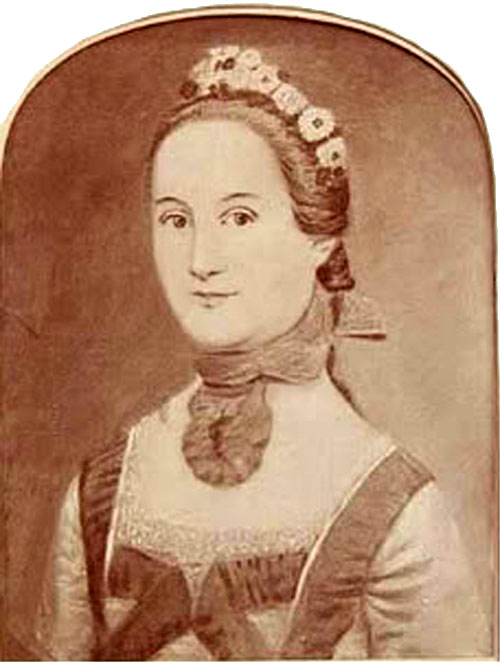
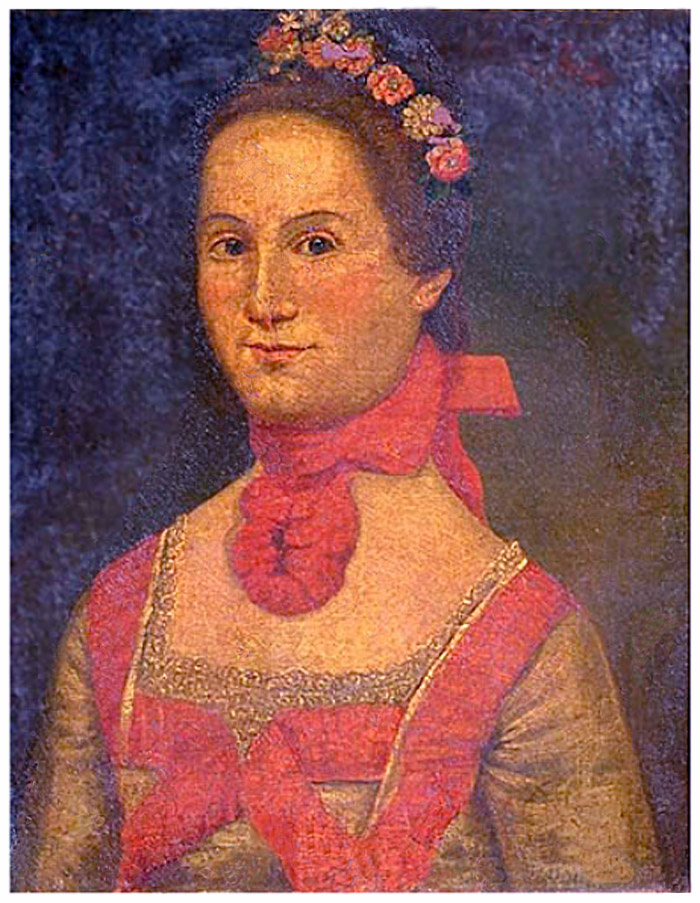
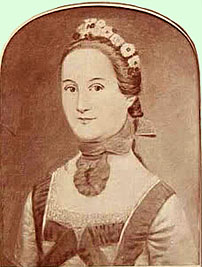
Charlotte Riverin (1750-1785)
Original, Musee national des beaux-arts du Quebec
Charlotte Riverin Antill
Marie-Charlotte was born in Quebec, Canada to the wealthy merchant Jean-Joseph Riverin and his wife, Marie-Charlotte Guillemin.
Her mother's father, Charles Guillemin (1676-1739), was another wealthy merchant, coming to Quebec in the late 1600's from Brittany,
where his father was a lawyer in the parliament of Brittany.
Charles was heavily involved in shipping as a ship builder, as well as
fitting out ships and acting as a commission agent.
Almost seventeen, Charlotte married twenty-five year old lawyer Edward Antill in 1767, and less than a year later had the first of her eleven
children, Isabella Graham Antill, named for Edward's grandmother, Isabella Graham, the wife of
New Jersey Colonial Governor Lewis Morris (randmother Morris had died when Edward was ten years old), or for his sister, Isabella Graham Antill,
who married the Reverend Robert McKean.
When Quebec City was under siege in 1775 and her husband joined the American army surrounding the city, Charlotte stayed with their
family. She joined her husband soon after as their next child, Amelia, was born 15 May 1777 in Lancaster PA but died December the same
year, just after Charlotte had written to the President of Congress asking for permission on November 17th
to join her husband, who had been captured by the British on Long Island in 1777.
Their next child was born 15 Dec 1779, and named for Edward's brother John, who had gotten him released from the prison ship in which he'd
been first incarcerated. John had taken the other side in the Revolutionary War, and become a Major in the British Army. Baby John
lived to be almost two years old. One other daughter was born on Long Island, Harriet (or Henrietta) whose godmother was Elizabeth Schuyler Hamilton,
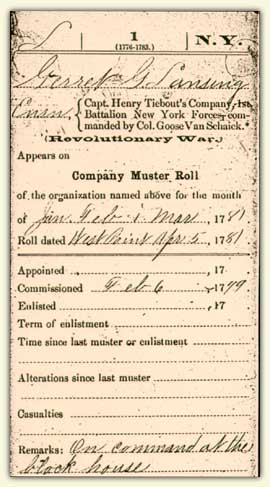
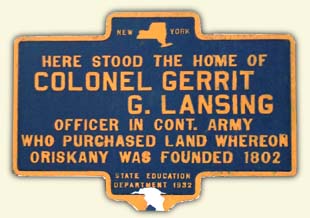
the wife of Alexander Hamilton, an officer with whom Antill served in Hazen's Brigade (Antill's son-in-law, Colonel Gerrit G. Lansing, also
served with both men at the Battle of Yorktown, which resulted in the surrender of Cornwallis). No date is given for Harriet's death.
After Antill was released in 1880, again by his brother John's influence, Charlotte had two more children, Louisa, who died at six months,
and Frances, a third daughter who also
survived to adulthood, along with Isabella and Mary. This time it was Charlotte, herself, who didn't long outlive the new baby, dying 03 Sep 1785,
when the infant was four months old. She was buried in St. Paul's Churchyard.
Edward left baby Frances with Elizabeth Hamilton, and returned to Canada, where his brother John had also gone when New York was liberated by
the young American army.
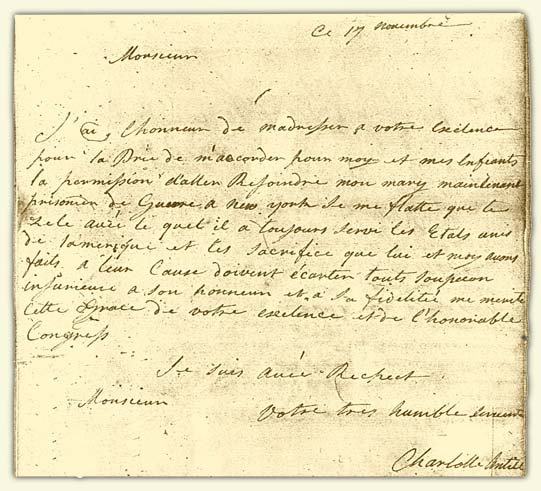
|
Charlotte Antill to the President of Congress
17th November
Sir
I have the honor of addressing myself to your Excellency to pray you to grant permission to me
and my children to go to my husband now a prisoner of war at New York. I flatter myself that the zeal with which
he hath always served the United States of America and the sacrifices which he & I have made in their cause ought to
scatter all suspicion injurious to his honor, and that his Fidelity will merit for me this Favor from your Excellency &
the honorable Congress.
I am with respect
Sir
Your very humble servant
Charlotte Antill
|
Lt. Colonel Edward Antill
Edward Antill, a New York merchant of the seventeenth century, and his descendents
William Nelson, 1899
Edward, first son of the said Anne [Morris], was born at the
same place [Piscataqua, in the County of Middlesex, in East New Jersey], the 11th of April, 1742,
at eleven of the clock in the morning, and was baptized in
the same church [Christ Church, New Brunswick NJ], by the Reverend William Skinner, on
Palm Sunday the 2d of May following, Peter Kemble of
this Piace, merchant, and doctor Mercer, of Bound
Brook, Gentn and Farmer, being his Godfathers, and Euphemia [Morris] Norris
(his aunt by the mother) his Godmother, who
being in England was personated by Mrs. Catherin Johnston.1
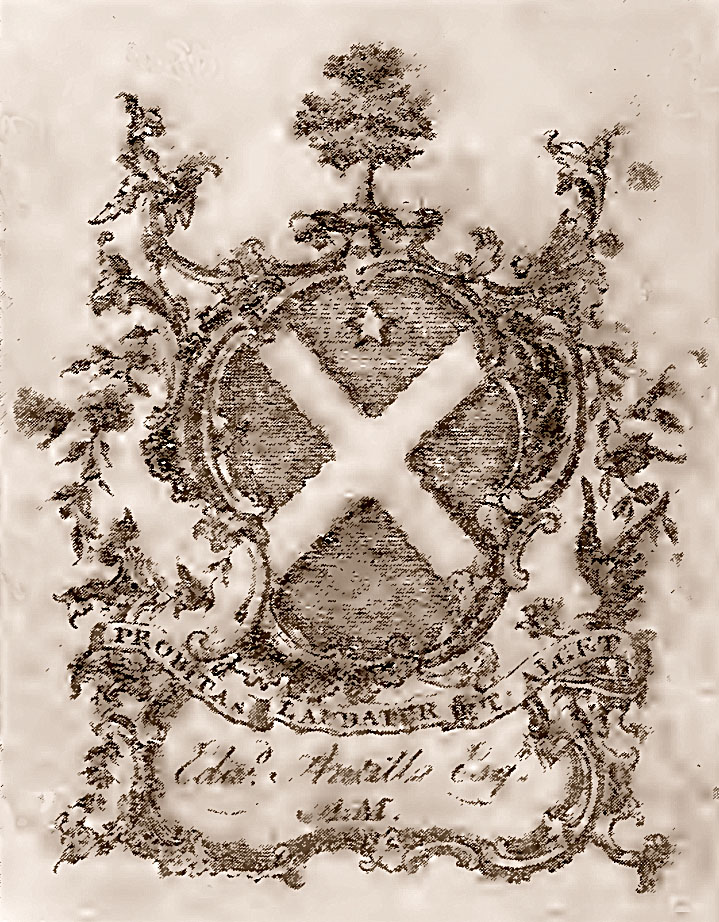
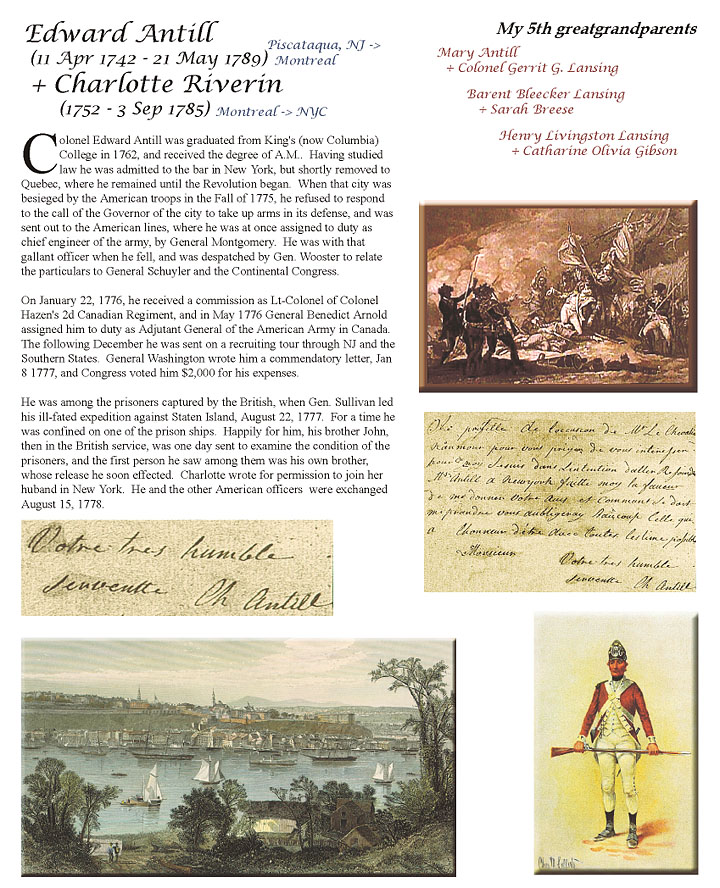
He was graduated from King's (now Columbia) College in 1762, and received the degree of A. M. in course, a
fact of which he was naturally proud, sufficiently so to note it on his very neat book-plate.
Having studied law he was admitted to the bar in New York, but shortly removed to Quebec, where he remained until the Revolution began.
When that city was besieged by the American troops in the Fall of 1775, he refused to respond to the call of the Governor of the city to take up arms in
its defense, and was sent out to the American lines, where to his delight he was at once assigned to duty as chief engineer of the army,
by General Montgomery. He was with that gallant officer when he fell, and was despatched by Gen. Wooster to relate the particulars to General
Schuyler and the Continental Congress.
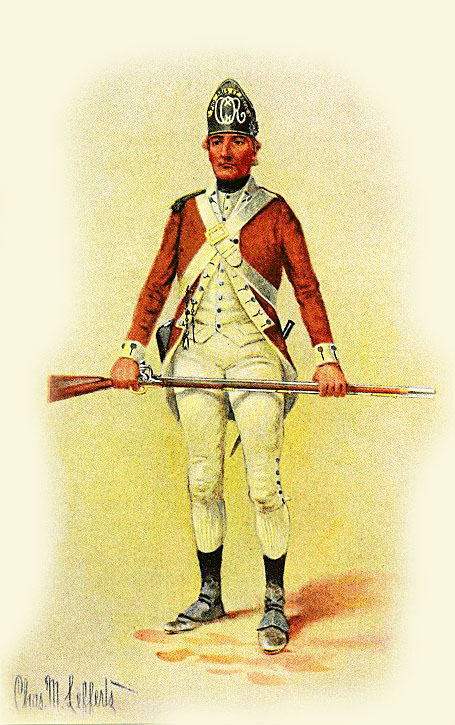
On January 22, 1776, he received a commission as Lieutenant-Colonel of Colonel Hazen's Second Canadian ("Congress Own")
Regiment, and in May, 1776, General Benedict Arnold assigned him to duty as Adjutant General of the American Army in Canada. In the following December he was sent
on a recruiting tour through New Jersey and the Southern States, with the approbation of General Washington (who
wrote him a commendatory letter, Jan. 8, 1777), and Congress voted him $2,000 for his expenses.2
He was among the prisoners captured by the British, when Gen. Sullivan led his ill-fated expedition against Staten Island, August
22, 1777.3
For a time he was confined on one of the prison ships. Happily for him, his brother John, then in the
British service, was one day sent to examine the condition of the prisoners, and the first person he saw among them
was his own brother, whose release he soon effected.4
He and other American officers made a return, at Flat Bush on Long Island, August 15, 1778, of the officers and other
prisoners on Long Island, for purposes of exchange.5
In August, 1779, he was still at large on Long Island, on parole.6
His exchange was effected Nov. 2, 1780.
On Jan. 7, 1782, he returned 77 men of his regiment belonging to the Pennsylvania line, who had not received
the gratuity allowed them7
He was retired from the service Jan. 1, 1783.8
He was licensed as an attorney in New Jersey at the November Term, 1783.9
About this time (1783-4) he opened a law office in New York city, at No. 25 Water
street, and later moved to No. 87 Broadway, corner of Wall street. In a letter dated "31 Golden Hill, New York City," December 16, 1785, he applied to John Jay, then
Secretary for Foreign Affairs, to be appointed Translator in the Department of Foreign Affairs. Secretary Jay replied
with his compliments that the office was not vacant. He then removed to Canada, joining his brother John
there.
He [had] married at Quebec, May 4, 1767 (the Rev. John Brooks, chaplain of the garrison, officiating), Miss
Charlotte Riverain, daughter of Joseph Riverain. She died at New York, September 3, 1785, aged thirty-two.
He died at the town of St. John's, on the Richelieu river, near Montreal, in Canada, May 21, 1789, aged
forty-seven years.10
(According to these dates she was but fourteen at the time of her marriage. Is there not an error here?)
[Yes. She was born 29 May 1750, and married 04 May 1767, just before her 17th birthday.]
He was appointed Judge of the Court of Common Pleas of Clinton County, N. Y., in 1789, but probably
died before he could fill the office.
1 Antill Family Record
2 N.Y. Hist. Soc. Coll. 1880, 208, 218; Force's American Archives, 4th Series,
IV., 189, 669; VI., 591, 1106; 5th Series, I., 654; III, 843, 1507, 1604, 1618; Penn.
Archives, 2d Series, XI., 99; Spark's Washington, IV., 267.
3 Marshall's Washington, III., 136; Penn. Magazine of Hist.
and Biog., III., 167; N.Y. Hist. Soc. Coll., 1883, 128.
4 Record Christ Church, 26.
5 Penn. Mag. of Hist. and Biog., XVII., 161.
6 N.Y. Hist. Soc. Coll., 1875, 241.
7 Penn. Archivess, IX., 476.
8 Heitman's Register, 64.
9 Antill Family Record.
New Jersey Archives
Edward had been in Canada ten years when the Revolution began, and being in Quebec in the Fall of 1775,
when that city was besieged by the American troops, he refused to respond to the call of the
governor of the city to take up arms in its defence; and was sent out to the American lines,
and gladly assigned to duty at once as chief engineer of the army, by General Montgomery.
He was with that gallant officer when he fell, and was dispatched by General Wooster to
relate the particulars to General Schuyler and the Continental Congress.
|
Edward Antill to Aaron Burr.
La La Chine, 5th January, 1776.
DEAR BURR,
I have desired Mr. Price to deliver you my pistols, which you will
keep until I see you. They are relics from my father's family, and
therefore I cannot give them to you. The general (Wooster) has thought
proper to send me to the Congress, where I shall have an opportunity
of speaking of you as you deserve.
Yours
Edward Antill
|
He was commissioned
Lieutenant-Colonel of Colonel Hazen's regiment, and in May, 1776, was assigned by
General Arnold to duty as Adjutant-General of the American army in
Canada. In the following December he was sent on a recruiting tour through New Jersey
and the Southern States, with the approbation of General Washington, and Congress voted him
$2,000 for his expenses.
John Antill joined the British, and became a Major in the New Jersey Volunteers.
On one occasion Edward was taken prisoner, and was confined on a prison ship.
Happily for him, John was sent to examine the prisoners, and the first person he saw was his own brother,
whose release he soon affected. In 1780 John was dismissed the service for embezzlement,
but four months later was restored to the command of his battalion. At the close of the war
John was obliged to go to Canada, where he was living in 1796.
He married (1772) Margaret, daughter of Alexander Colden, son of Lieutenant-Governor Cadwallader Colden,
and after her death married her sister Jane.
SOCIETY OF THE CINCINNATI
Born on the 11th April, 1742, at Piscataway, N.J. Died at St. Johns, Canada, in 1787.
He graduated at King's College, New York, in the CLass of 1762. Was a member of a prominent family of New Jersey.
In 1766 he settled in Quebec as a lawyer, where he married Charlotte Riverin. When General Montgomery appeared before Quebec
in December, 1775, he left that city, and joining him, influenced him to change his plan of attack.
He became his Chief-Engineer, constructing field works of ice, where earth was inaccessible, and was
present with him when he fell. When leaving the camp at Lachine on the 5th of January, five days afterwards,
he wrote to Colonel Burr.
In 1776, when Congress formed the 2d Canadian Regiment mainly of exiles, Colonel Moses Hazen, a British half-pay officer
in easy circumstances, residing at St. Johns, and who had already cast his fortunes with Montgomery,
and followed the remainder of the American forces over the frontier, was chosen its Colonel,
and Edward Antill Lieutenant-Colonel. It was even then a strong regiment - seven hundred and
twenty men - but Congress appears to have valued it in ordering it to be it to be recruited in
any of the States to four battalions of five companies each, with four Majors and other officers in proportion.
Sixteen companies, however, appear to have been the fullest complement of what was known as
"Congress' Own," It had evacuated Canada, under General Sullivan, and therefore continued in his
Brigade, which served with the main army at Trenton and Princeton, and later, in protecting
the lines at Morristown. On the 8th of January, 1777, General Washington wrote him from his headquarters
there a letter suggestive of coming action:
"Call upon all your officere who are upon recruiting service to exert themselves as much as possible in
filling their companies and sending their recruits forward to some general place of rendezvous, that they
may be armed, equipped and got into service, with as much expedition as possible. As you and Colonel Hazien
had the nomination of your own officers by virtue of your commissions, I shall have no objection to
any gentleman of good charscter whom you may think fit to appoint,"
On the 24th of February following, Richard Peters, Secretary of War, urges, in a letter, upon Colonel Antill,
then commanding the regiment, the necessity, from impending events, of promptness in hurrying his companies
forward to unite in meeting the enemy.
In complying, the regiment was soon actively engaged under Sullivan, and when he attacked the
rear of Howe's army on Staten Island - consisting of three thousand British and loyalists -
with eight hundred men, on the 22d of June, after partial success succumbed to the vigorous
resistance, he became a prisoner, thereby losing his opportunity of being present at
Brandywine, Germantown, and in much important service with his regiment.
He was not exchanged until November 10th, 1780, and only then through
the influence of his brother. Major John Antill, who, differing in sentiment,
adhered to the Crown,
Rejoining his regiment at Flshkill, he soon afterwards assisted in beating up
the quarters of Colonel James de Lancey at Morrisania, for which he earned the
thanks of Washington, in general orders.
In August he marched to Philadelphia, joining Colonel Olney's Rhode
Islanders, and proceeding by the Chesapeake and James River to Yorktown
and the surrender of Cornwallis.
Although he had asked Congress to be relieved from service in an earlier
period of inactivity, he continued therein until the disbanding of his regiment in November, 1783.
Not found on the Half-Pay Roll, he appears on the Balloting Book of New
York in the list of Canadian and Nova Scotia refugees, who had united
with the Americans, to whom lands were granted by the State under the direction of its
commissioners.
The following letter, preserved among the Society's archives, is of interest:
|
COLDENHAM, July 7th, 1783,
My Dear Friend, 6 o'clock.
Retired from the din of arms and a military life clothed with laurels, and the thanks of a
most grateful country, all my pay and arrears of pay paid up to this day in solid gold, and a
pension of half pay for Life, I now amuse myself with my Dog and my Gun. I send the bearer
on a little business to General Knox, and at the same time after enquiring after the health of
your good little woman, in which Mrs. Antill joins me, I beg the favor of you to fill my powder
horn with the best powder you have. If the U.S. insists upon it, I will deduct it out of the
Guineas I received from them when we were disbanded.
Compliments to your good Family and all Friends.
Yours Sincerely
Edwd Antill.
Major S. Bauman
West Point- per Express.
|
His wife resided in New York during the war, died there on the 3d of
September, 1785, and was buried in St. Paul's Churchyard. Colonel Antill
returned to his old home at St. Johns, and also died soon after. His eldest
daughter, Mannette, married Colonel Garrit G. Lansing, of Albany, and his
youngest, Frances, became the wife of Arthur Tappan, Esq.
It will be seen by "Whiting's Revolutionary Orders of Washington" that his
useful life was not free from one of those Courts of Inquiry that attend such
men as venture upon authority, and that after an impartial investigation he
was honorably acquitted.
He subscribed his name to the Institution of the Cincinnati with the officers
of his regiment on the Parchment Roll, with Washington at its head, now in
the possession of the General Society.
DAR
Edward Antill, (1742-89), a graduate of Columbia College, volunteered 1775, under Montgomery and was
appointed chief engineer. In 1776 he was lieutenant colonel of Hazen's regiment, "Congress Own" was captured
on Long Island and not exchanged until 1780.
While a paroled prisoner of war at Flat Bush, Long Island, Edward Antill wrote or copied a group of
scientific papers
[Historical Society of PA, Group 9].
Subjects include "The principles of geology and astronomy," "elements of chronology," "elements of all the syllables within the English language," "a table of the sun's declination from 1764 to 1795," and a table showing the number of miles to each degree of longitude and latitude.
He commanded Hazen's regiment at Yorktown, and served until peace
was declared. He was born in Piscataqua, N. J.; died in St. Johns, Canada.
Walking the Berkshires
Tim Abbott's Blog (April 6-8, 29011): Sullivan's Staten Island Raid
Abbott does a brilliant job of examining Sullivan's raid in great detail, including Sullivan's accusations against Antill, whom Sullivan
seemed to have thought defected to the enemy rather than having been captured. Well worth the long read.
Edward Antill's Astrological information
Documents Relating to the Colonial History of New Jersey Vol XXIV
New-York, May 30. On Tuesday last Week our Annual Commencement was held at Trinity Church, in
this City. . . . . After Prayers and a Latin Oration by the Rev. Mr. Myles Cooper, President of the College,
Orations were delivered by Mr. Benson and Mr. Schuyler (Son of Col. John Schuyler, of the Jersies) in
Latin, and by Mr. Livingston, (Son of Judge Livingston) and Mr. Antell in English. . . . .
After the Exercise, the President conferr'd the Degree of Bachelor of Arts upon Messrs. Lloyd, Benson,
Schuyler, Grant and Livingston. And the Degree of Master of Arts, upon the Rev. Mr. Leaming, the Rev.
Mr. Hanna, Mr. Antell, Mr. Cuyler and Mr. Leslie.
Edward Antill, born at Piscataqua, N. J., April 11, 1742, son of
Edward Antill, 2d, and Anne Morris, daughter of Gov. Lewis Morris.
He was graduated from King's College in 1762, and was admitted to the
New York bar, but removed to Quebec; at the beginning of the Revolution
he took sides with the Americans, and was commissioned as a
Lieutenant Colonel, serving until 1783. He was licensed as an Attorney
in New Jersey in 1783, and had an office in New York. He died at St.
John, near Montreal, May 21, 1789. See "Edward Antill, a New York
Merchant of the seventeeth century, and his descendants," by William
Nelson, 1900.
Timothy and Rhoda Ogden Edwards
CHILDREN OF WILLIAM W. EDWARDS AND HELEN ANN MANN.
Colonel Edward Antill, of New York and Charlotte Riverain, of Montreal. Lt. Colonel Antill was with General
Montgomery, as his Chief Engineer, in the attack on Quebec, 1775; appointed by General Benedict Arnold
Adjutant General of the American Army in Canada, 1776; was the intimate friend of General Alexander
Hamilton, who became godfather, and, later, guardian to his infant daughter, Frances, afterwards the
wife of Arthur Tappan.
|
|



 Copyright © 2002, Mary S. Van Deusen