mailing websites database queries books military
nav bar
family tree


The Davis Branch

branch

Benjamin F. Davis Jefferson Davis


Benjamin Franklin "Grimes" Davis
(ca. 1832-1863)

Who Was Who in the Union p.106

During a dramatic escape from beleaguered Harpers Ferry, Benjamin F. "Grimes" Davis was able to capitalize on his Southern accent to capture James Longstreet's reserve ammunition train. The Alabama-born West Pointer (1854) and wounded veteran of Indian fighting in the infantry and dragoons along the Gila River in New Mexico, had remained loyal to the Union. His Civil War-period assignments included:

  • First Lieutenant - 1st Dragoons (January 9, 1860)
  • Captain - 1st Dragoons (July 30, 1861)
  • Captain - 1st Cavalry (change of designation on August 3, 1861)
  • Lieutenant Colonel - 1st California Cavalry (August 19, 1861, resigned November 1, 1861)
  • Colonel - 8th New York Cavalry (June 25, 1862)
  • Commanding - 5th Brigade, Cavalry Division, Army of the Potomac (September-November 1862)
  • Commanding - 1st Brigade, 1st Division, Cavalry Corps, Army of the Potomac (February 16-May 27 and June 6-9, 1863)
  • Commanding - Division (May 27-June 6, 1863)

Briefly serving in the California volunteers, he resigned that commission when his regular army regiment was ordered to the East. He fought in the siege of Yorktown and at Williamsburg before being assigned to command a New York regiment in the early summer of 1862.

Serving in the vicinity of Harpers Ferry, the regiment was entrapped at that place during the Antietam Campaign. Davis urged upon his commander that all the cavalry at the doomed post be allowed to cut their way out. It was reluctantly agreed to and the attempt was made on the night of September 14, 1862. After a series of minor collisions with Confederate pickets, the 8th managed to stumble upon the enemy wagons and Davis was able, the darkness concealing the color of his uniform, to order the train into his column. Many of the teamsters did not know they were prisoners until daylight. He was brevetted for his action.

Joining the Army of the Potomac, Davis commanded a brigade at Antietam and his regiment at Fredericksburg. During the Chancellorsville Campaign he took part in Stoneman's Raid. The next month he was killed, commanding a brigade, in the great cavalry battle at Brandy Station.
(Murfin, James V., The Gleam of Bayonets)


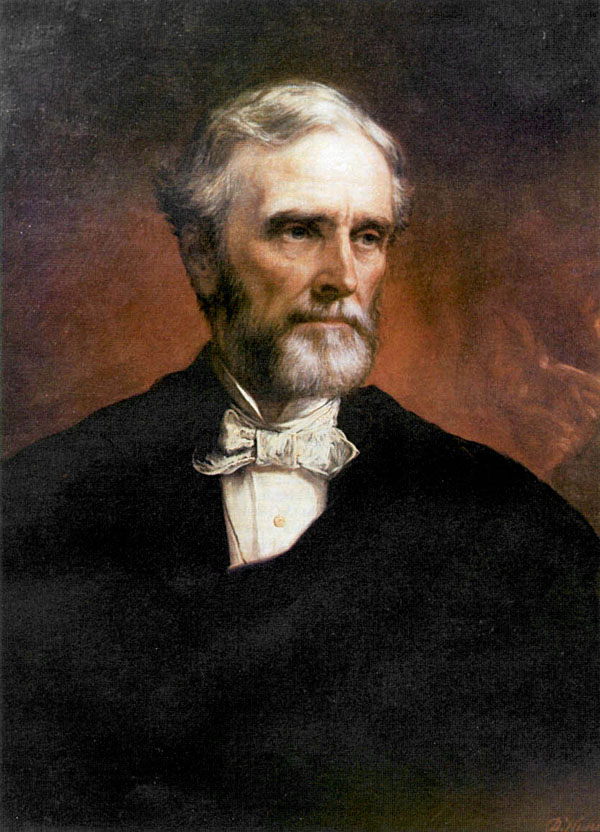
Jefferson Davis
(ca. 1832-1863)

Who Was Who in the Confederacy p.106

The only president of the Confederacy, Jefferson Davis proved to be something less than the revolutionary leader necessary to lead a fledgling nation to independence; he himself would have preferred to serve as a military leader. Born in Kentucky, he was graduated from West Point in 1828 and was posted to the Pacific Northwest. There he served with the infantry until 1833 when he transferred to the dragoons.

Two years later he resigned as a first lieutenant when he eloped with the daughter of his commander, Zachary Taylor. Thereafter a Mississippi planter, he lost his wife shortly after the wedding and then married Varina Howell.

Elected as a Democrat to Congress he served in the house of Representatives from 1845 to 1847. During the Mexican War he compiled an enviable record as colonel of the 1st Mississippi Rifles. Wounded at Buena Vista, he turned down a commission as a brigadier general. He then won a seat in the U.S. Senate, which he held until named Franklin Pierce's war secretary in 1853. He held this post for the full tenure of the Pierce presidency and then won reelection to the Senate.

A staunch supporter of states' rights, he backed his state's secession and made a powerful speech on the floor of the Senate when he and four other senators withdrew from that body on January 21, 1861. Almost immediately named commander of the state military forces with the rank of major general -- in recognition of his Mexican War service -- he became a compromise candidate for the provisional presidency of the Confederacy and was so elected on February 9, 1861. Inaugurated nine days later in Montgomery, Alabama, he was elected as regular president for a six-year term on November 6, 1861, and was reinauguared on Washington's Birthday in Richmond.

His interest in the military defense of his country soon became apparent; his early war secretaries served as little more than clerks as he himself supervised the affairs of the department. He made frequent forays into the field, arriving at 1st Bull Run just as the fight was ending, and was later under fire at Seven Pines where he placed Robert E. Lee in command of what became the Army of Northern Virginia.

Later he toured the western theater where he supported his old friend Braxton Bragg agaionst the criticisms of his subordinates. His handling of the high command was extremely controversial. There were long-standing feuds with Beauregard and Joseph E. Johnston. His defense of certain non-performing generals, such as Bragg and Pemberton, irritated many in the South.

On the political front his autocratic ways fostered a large and well-organized anti-Davis faction in the Confederate Congress, especially in the Senate. His attempts to manage the war effectively by placing more power in the hands of the central government were often thwarted by the states' rights philosophy that had led to its very founding. It is quite apparent that he is more popular in the South today than he was during his tenure.

Upon the fall of Richmond he fled south with the remnants of his governmenbt and was finally captured near Irwinville, Georgia, on May 10, 1865. He was sent off to prison at Fort Monroe, faced with charges of treason. Never brought to trial, he was finally released on bail after two years of confinement.

Always contentious, he wrote his autobiography entitled The Rise and Fall of the Confederate Government. In this 1881 work he refought the war, including his views of those feuds with officers like Beauregard and Johnston who received much of the blame for the Confederacy's demise. He lived out his remaining years in Mississippi, never seeking to have his citizenship restored. In spite of this, it was restored during the presidency of Jimmy Carter.
(Eaton, Clement, Jefferson Davis)

The Papers of Jefferson Davis Jefferson Davis' Last Home


separator


stampDAVIS MAILING LISTS

You can join the Davis family mailing list by typing the word "subscribe" (without the quotes) as the only text in the body of a message to the regular mailing list or the digest form of the mailing list.

You can also submit an email for posting on the list.


crestDAVIS WEB PAGES

Index to Politicians: Davis
Lots of Davis Information and books too
Lori Davis Java InterneTree
Descendants of James E. Davis (b:1785, VA) - Hint: You can read text against busy backgrounds by swiping the text and reading it swiped; brings up security dialog box
Davis/Hawes Genealogy on the Web
Descendants of John Phillip Davis
Davis Family Records Research
A truly original Davis Family site
Descendants of Charles Davies (b:Abt. 1706, Eng) (d:NC)
Davis Family History of Larry Baker
Davis Family in Southwest Virginia
Moye-Davis-Fisher (African-American)
The Davis Clan Plus Some Ancestors
DAVIS Genealogy - NC and TN
Examples of Davis Coats of Arms
Diggin' for Davises - Golden West Marketing Genealogical Research
Descendants of Simeon Davis Sr (b:1767)
Penny Ling's Davis and Davies Names
Lydia Adams Davis - Singer/Songwriter
Haverhill MA Community Information and Guide


laptopDAVIS ONLINE DATABASES

Haverhill, MA - Selected data only
Births
Deaths

Photographs of Davis' in the Civil War
Immigrant Ancestors
Davis Individuals in My Family Tree
Revolutionary War Davis' - currently 8
Lineages Davis Family Pages Search - 10
Link List of Searchable Genealogy Sites
Shawna's Searchable Records
Search 300 Million Names

GENERAL GENEALOGICAL SURNAME SEARCHES
(Number of entries as of 12/29/97)
GENDEXs 13,7214 Davis entries
Family Tree Maker many Davis entries
Rootsweb Search Search by State
Rootsweb Immigrant Ancestors Ffulke Davis, bef 1636
Ancestry World Tree 6708 Davis entries
I Found It! 69 Davis entries
Social Security Death Index many Anderson entries
Rootsweb Surname Searchers many Anderson searchers


queriesDAVIS QUERIES

Genealogy of James Davis of Haverhill MA
Davis Family Genealogy Forum
Davies Family Genealogy Forum


booksDAVIS BOOKS

Davis Family of NJ and Upstate NY
H. Johnston. 10p. $4.00

Descendants of William Davis & his wife Mary Means
T.K. Davis. 248p. 1912. $39.00

Davis (Davies and David) Family in Wales and America
Genealogy of Morgan David of Pennsylvania, by Harry A. Davis. 445p. 1927. $67.00

Davis-Adams Genealogy
Bell Shank Cadmus. 82+38p. 1931. $19.50

Davis Family of Early Roxbury & Boston
S. F. Rockwell. 326p. 1932. $49.00

Davis Records - Washingon Co., Ohio
Early Gateway to the West, by H.C. Biedel. 43p. 1952. $8.50

Davis-Woodruff Families of Western Kentucky
Virginia Couchot. 74p. 1992. $15.00

Davis, Kinder & Noble Reunions & Family Trees
223p. 1926. $33.50

Dolor Davis, a sketch of his life
with record of his earlier desc., by H. Davis. 46p. 1881. $9.50

Descendants of Charity Davis of Oxford CT
G.T. Davis. 4p. 1883. $4.00

Samuel Davis of Oxford MA & Joseph Davis of Dudley MA
G. Davis. 618p. 1884. $77.00

Descendants of John Davis, a Native of England
Who died in East Hampton, L.I., in 1705. Brought down to 1886-87, by A. Davis. 199p. 1888. $30.00

Davis & Goss families
in two parts, by H.W. Clark. 122+141p. 1905. $59.50

Jefferson Davis
address delivered Oct. 9, 1908, before Lee Camp # 1, Conf. Vets, Richmond, Va., by W.H. Whitsitt. 16p. 1908. $5.00

Three generations of Northboro Davises, 1781-1894
John D. Estabrook. 84p. 1908. $17.00

Descendants of Colonel John Davis of Oxford CT
with partial gen. of his anc., by G.T. Davis. 338p. 1910. $53.50

One line of Descent from Dolor Davis & Richard Everett
W. S. Crosby. 59p. 1911. $12.50

Joseph Davis (1773-1865) of Norway, NY
Ancestry & Posterity of Davis and his wife Elizabeth Hallock Davis, by Wm. Church Davis. 172p. 1927. $27.00

Davis Family and Allied Lines
T.C. & W.C. Davis. 40p. 1934. $8.00

John Davis of Chebacco (Ipswich)
And some of his descendants, by E. A. Davis. 24p. 1934. $5.50

Clinton H. Davis family
Short sketch of the Lost Creek 7th Day Baptist Church, by W.M. Davis. 100p. 1935. $19.00

Ancestors of the Davis Brothers
Philip Christopher Davis, George G. Davis, Joseph G. Davis, James C. Davis and John Edw. Davis, by Geo. W. Davis. 122p., typescript. 1955. $21.00

Wm. Davis of London, England, 1764-1809
Mildred F.D. Barr. 71p., typescript. 1957. $14.00

Davis Family of Haverhill & Dover MA
(Extracted from The Old Families of Salem, Part Nine & Ten) 40p. $8.00

Davis
(Extracted from The History of Washington, NH) 25p. $5.50

Davis
(Extracted from General Notes of Barnstable Families) 30p. $6.00

A selection of Davis Family Books


militaryDAVIS MILITARY SERVICE

Photographs of Davis' in the Civil War
Bio. of Civil War soldier Benjamin F. "Grimes" Davis
Bio. of Confederacy President Jefferson Davis
Lt George E. Davis, Medal of Honor winner
How to Request Civil War Military Records
Practical advice on obtaining military records
How to Request General Military Records
National Archives Microfilm Publications
U.S. Army Center of Military History
Cyndi's List of Military Resources Worldwide
See also: Databases

The Civil War: Strange & Fascinating Facts
Burke Davis
Frederick Volck, a foreign sculptor who lived in Richmond, covertly made a bust of Jefferson Davis by attending church each Sunday for weeks, sitting near the President, studying his head without attracting attention.

When the completed bust was unveiled, Richmond society greeted it with delight; it won a place of honor in the Confederate White House, and was chosen as the design for another stamp. A proof of the stamp was approved by the President and by Colonel H. St. George Offutt, chief of the contracting bureau -- but there was trouble ahead.

An eccentric Englishman who seemed to wield a social tyranny over the Davis household, Colonel W.H. Browne, was wounded because he had not been consulted in this artistic project. Browne was an aide to Davis, and during a reception at the Mansion he approached Mrs. Davis:

Have you seen the new stamp they have made of the President?"

"No. Could I see it?"

Browne took from his pocket a sample proof, and with one breath doomed the stamp:

"Note the strong resemblance to President Lincoln."

The stamp was withdrawn from circulation almost immediately without fanfare. The result was a relatively rare stamp, and one hailed by collectors as perhaps the finest produced in the South, dominated by a simple drawing of the head of Davis with a cameolike quality.


ImmigrantsemptyRoyalempty
surnames
emptySurnamesemptyIndex of People
Family Tree Home

Home Favorites Map


IME logo Copyright © 1997, Mary S. Van Deusen