Henry Livingston, Jr.
 (13 Oct 1748, Poughkeepsie NY) (13 Oct 1748, Poughkeepsie NY)
(29 Feb 1828, Poughkeepsie NY)
(son of Henry Livingston, Sr. and Susannah Conklin)
+ Sarah Welles (18 May 1774, Stamford CT)
(7 Nov 1752, Stamford CT)
(1 Sep 1783, Stamford CT)
(daughter of )
Children:
|
Charles Paterson Livingston and Elizabeth Clement Brewer
|
|
Charles Paterson Livingston was born May 18, 1794, at "Locust Grove," the estate of his father near poughkeepsie, and was baptized Aug. 20, 1794, in the Dutch Church there. he died Aug. 29, 1847, aged 53 years, in Painesville, Ohio, where, besides being a practicing physician, he was also mayor of the city. On Jan. 5, 1826, he married, the Rev. John Reed rector of Christ church, Poughkeepsie, officiating, Ellizabeth Clement Brewer who was born July 13, 1798, in Yorktown, Westchester County, NY, and died Apr. 2, 1878, in Sandusky, Ohio, a daughter of Dr. Joseph & Hannah (Mitchell) Brewer. Dr. Livingston is buried in Painesville and his wife in Sandusky, as she made her home there with her daughter, after her husband's death.
Dr. Livingston and his wife left Poughkeepsie in May 1825 for Cleveland, Ohio. He had lived for seven years in Kaskaskia, IL, but was obliged to leave there on account of ill health; however, he had visited Cleveland and liked it, so he decided to settle there. They went by boat to Albanyand by canal to Dunkirtk NY, and there waited a week for the lake boat. They received a warm welcome on their arrival in Painesville and found there several families that they had known, or had known of, in the East. While Dr. Livingston had planned to establish his home and practice in Cleveland, he realized that there was a greater need for a physician in the smaller community of Painesville so he decided to settle permanently in the latter place. He was a Surgeon in the Black Hawk War, commissioned Jan. 22, 1830, by Allen Trimble, Governor and Commander-in-Chief in Ohio, in the "1st Squadron Cavalry, 1st Brigade, 8th Division, in the Militia of this State" (Fam. recs.).
Several letters, written by him in his twenties, have survived. One, dated Utica, N.Y., Sept. 3, 1817, to his mother, tells of visiting the Breeses, Platts, and other family relatives and that he expected to return home by way of Newburgh, N.Y., where he hoped to form a partnership with a physician. Two years later he was in Illinois, for in a letter of Sept. 4, 1819, addressed to his father, he speaks of his recent arrivial in Kaskaskia and exhibits great enthusiasm about the western country. A few years later his attitude had changed for on Oct. 26, 1824, he wrote: "I have almost determined to leave this country next spring, and as soon after as may be, locate in Ohio, say at Sandusky, Cleveland, or Erie. Times are hard [and] I shall not be able to collect much money..."
|
|
Edwin George Livingston
|
|
He grew up in the family home, Locust Grove, in Poughkeepsie, but family letters give the impression that he was a rolling stone. He stayed for a time with his older brother, Dr. Charles P. Livinston, when he lived in Kaskaskia, Ill., and later in Painesville, Ohio. In a letter of his nephew, Henry Livingston of Babylon, L.I., dated Jan. 10, 1900, now in the archives of the New York Historical Society, it is stated that Sidney M. Livingston owned the original mss. of "The Night Before Christmas," and that he gave it to his brother, Edwin George. Edwin's personal effects were destroyed when the home of his sister, Susan L. Gurney (with whom he was then living in Waukesha, Wis.), was destroyed by fire about 1847-1848, and this manuscript with them. Edwin apparently spent the last years of his life with the Gurneys, and he held a mortgage on their farm. He is buried in their family plot in the Nashotah, Wis., Mission Cemetery. In his will, he left $500 to the above-mentioned nephew, Henry Livingston of Babylon, L.I.
|
|
Helen Platt Livingston and Wakeman Bradley
|
|
Wakeman Bradley was a merchant and capitalist at North East and Poughkeepsie. He was born 22 Sep 1783. His first wife, Mary Winchell.
was born in North East 25 Jun 1787, where she married Wakeman Bradley. They had one son, Martin Mills Bradley. Mary died in Poughkeepsie 25 Dec 1851. He remarried Helen Platt Livingston 30 Mar 1853, but they had no children.
|
|
Elizabeth Davenport Livingston and Smith Thompson and Richard Ray Lansing
|
|
Smith Thompson was born about January 17, 1768, in Dutchess County, New York. He was graduated from Princeton University in 1788 and taught school and read law with an attorney in Poughkeepsie. In 1793, he joined a Poughkeepsie law firm. In 1800, Thompson was elected to the New York State Legislature, and one year later he served as a delegate to the New York State Constitutional Convention. In 1802, Thompson was appointed State District Attorney for the Middle District of New York, but before assuming his duties he was appointed to the New York Supreme Ct. He served there as an Associate Justice for twelve years and was named Chief Justice in 1814.
Thompson resigned from the New York Supreme Court in 1818 to accept an appointment as Secretary of the Navy from President James Monroe. He served in the cabinet until 1823 when, on December 8, President Monroe nominated him to the Supreme Court of the United States. Thompson gave up plans to run for President in 1824 and accepted the Supreme Court appointment. The Senate confirmed the appointment on December 19, 1823. Thompson served on the Supreme Court for twenty years. In 1828, while still on the Court, he made an unsuccessful run for Governor of New York. Thompson died on December 18, 1843, at the age of seventy-five.
Amistad: The Federal Courts and the Challenge to Slavery
Smith Thompson (1768-1843), Associate justice of the Supreme Court and circuit justice on the U.S. Circuit Court for the District of Connecticut.
Justice Smith Thompson participated in three separate stages of the Amistad case’s passage through the federal court system. As the justice assigned to the circuit courts for the Second Circuit, Thompson presided over the brief hearing of criminal charges directed against the Amistad captives in September 1839, and he ruled that the Mende could not be prosecuted in the courts of the United States for alleged acts that occurred on a foreign vessel at sea. During this same session of the circuit court, Thompson presided over the abolitionists’ appeal for release of the Mende under a writ of habeas corpus. He expressed his personal abhorrence of slavery, but reminded the lawyers that the Constitution and laws of the United States recognized the right of one person to control the labor of another. His duty, as he announced it to the court, was not to rule on the abstract right of slavery but on the proper jurisdiction of the district court. The justice denied the release of the Mende as long as they were the object of property claims pending before the district court.
Thompson again presided over the U.S. Circuit Court for the District of Connecticut in April 1840 when that court heard the U.S. Attorney’s appeal of the district court decision ordering that the Mende should be returned to Africa. Thompson affirmed the district court decision without comment, on the assumption that it would in any case be appealed to the Supreme Court. He also rejected the plea from the Mende’s lawyers that the case be dismissed on the grounds that the United States had no interest in the Spanish property claims on which it based the appeal.
Justice Thompson then heard the arguments presented before the Supreme Court and joined the opinion written by his colleague Justice Story. In all of these proceedings, Thompson had little opportunity to comment on the merits of the various claims alleging that the captives from the Amistad were lawfully-held property of the Spanish planters.
Smith Thompson was born in New York and attended the College of New Jersey (now Princeton University). He read law with James Kent, one of the most influential jurists and legal writers in the early republic. After a brief term in the state legislature, Thompson was appointed to the New York Supreme Court in 1802 and became chief justice of that court in 1814. He left the New York court in 1818 to accept President James Monroe’s nomination to serve as secretary of the navy. During his tenure as a cabinet secretary, the navy was responsible for enforcing the prohibition on the international slave trade, and Thompson was directly involved in the cases of two slave ships, the Antelope and La Jeune Eugenie, both of which became the subjects of federal court cases that served as precedents for Amistad.
In 1823 Monroe appointed Thompson to the Supreme Court of the United States. Thompson was assigned circuit duties in the Second Circuit, which consisted of New York, Connecticut, and Vermont. On the Court, Thompson supported a state rights position that was often in opposition to the nationalist ideas of Chief Justice John Marshall. He served on the Supreme Court until his death on December 18, 1843.
Richard Ray Lansing, the eldest of their sons, who was born
in July 1789, and graduated at Union College in 1809, pursued
his professional studies with Judge Jonas Platt and then established
himself in Utica, marrying soon afterward Susan, the daughter of his preceptor.
Declining to take up with the offer
of George Parish, a great land holder of the northern part of
the State, and become his agent in the sale of lands, as this
involved the requirement that he should live at Mexico, in Oswego county,
he entered, in 1815, into partnership with Judge Morris
S. Miller. Ere long he was made clerk of the District Court of
the United States, and held the office during his residence.
Being industrious, punctual, accurate and rapid in all his interactions,
he acquitted himself excellently. His partners, after
Judge Miller, were successively, G. John Mills, John H. Ostrom and
Abraham Varick. He lived in Utica until about 1829, at
first on Broad street, between Genesee and John, and later
in the house on Chancellor square that is now the home of Mrs.
Nicholas Devereux, which he built about 1825.
Mr. Lansing was cultured, agreeable and companionable, fond
of society and of entertaining. He was fond also of his fishing
and his gun. The weight reported of some of his piscatotorial
captures seem akin to the fabulous, while his skill as a sportsman
made him a popular fellow of the once notorious Unadilla Hunt.
With rare bonhommie he was no less a bonvivant, for he loved the gains of his sport, and
was an amateur of good things. But his economy was not proportionate
with his industry, nor his tastes in harmony with his necessities, and so,
though his gains were not small, he lived faster than he could
afford, and found himself embarrassed in the end. The flood
tide of his fortune, which the poet intimates as coming but once
in a lifetime, would seem to have been opened to Mr. Lansing
by the offer of Mr. parish. Neglecting this, he was left upon the shoals,
and had to struggle hard to support a numerous family
in an expensive way of living. Removing to New York,
he entered upon the importation of wines and liquors, and for
some years Lansing, Munroe and King were among the heaviest leaders in their line.
But on returning to his store from his residence up town on the morning after the great fire of December 1835,
he discovered that he had been burned to the ground and that his insurers as well as himself were ruined. He left
the city and went to Michigan. He became identified with the growth of that new State, was interested in land
sales, and among the first to engage in the mining of copper on Lake Superior. In these transactions he was aided
by the fortune he acquired through his second marriage.
For having lost his first wife while in New York,
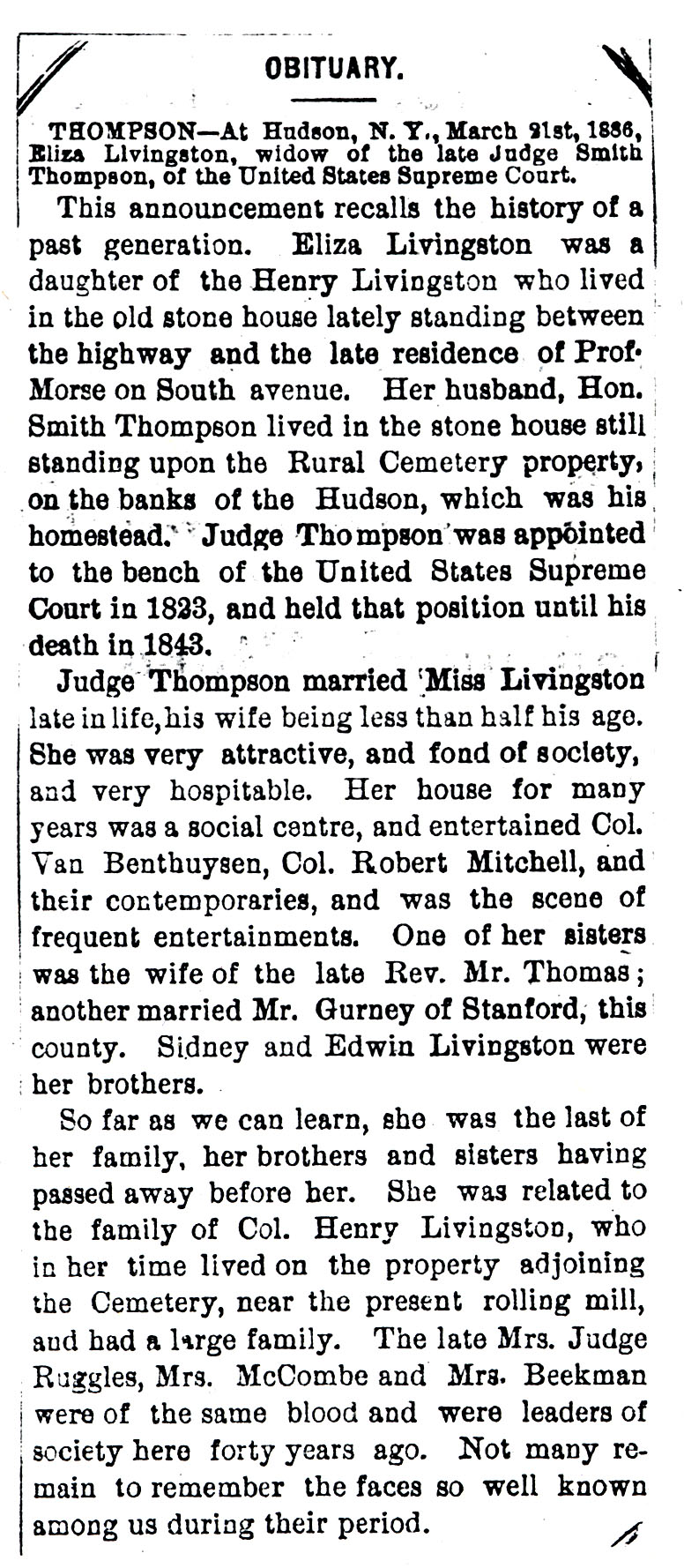
he married her cousin, Eliza, daughter of Henry Livingston, and widow of Smith Thompson, judge of the
Supreme Court of New York. For a few years he resided in Lansing, the capital of Michigan, to which place
he had the honor of giving its name.
And it happened something on this wise: while on one of his fishing excursions,
he stopped, as he had often done before, at a "four corners" where the half store, half-tavern had drawn
around it a few rude buildings. The inhabitants aspired to a name, and were then
assembled to choose one. Some were advocates for antiquity and more for home recollections, but they were quite
unable to agree, when someone called out: "Here's Dick Lansing, the cleverest fellow that ever came to these corners, let's
call it after him." At once they assented and so gave appellation to the future capital of their State. It was not there,
but at Detroit the place of his final residence, that he died Sept 29, 1855.
He was the father of thirteen children, all of them the offspring of the first Mrs. Lansing.
[The pioneers of Utica, M.M. Bagg, 1877.]
|
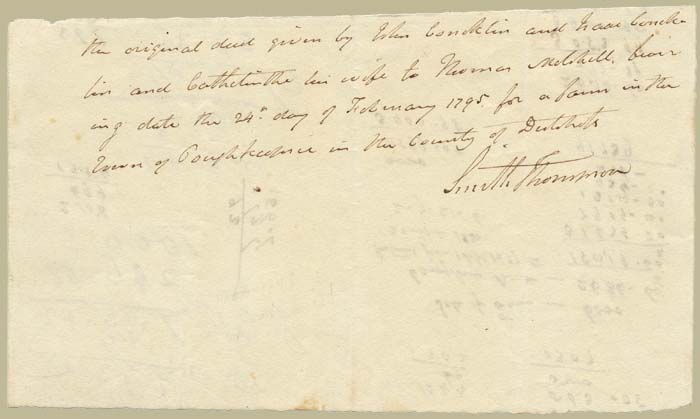
John and Isaac Conklin, the brothers of Eliza's grandmother, Susannah Conklin
|
Abram Gifford Gurney and Susan Catherine Livingston
|
|
A. GIFFORD GURNEY, farmer, Sec. 14; P. O. Delafield; was born in Duchess Co., N. Y., in 1809; his father, David Gurney, was also a native of that county, and followed farming for a livelihood. Our subject, A. G., spent his time at the same vocation till 1836, when he began business for himself, and followed teaching and farming till 1846; he then emigrated to Wisconsin and located on his present farm, where he now owns 80 acres. He was married in January, 1846, to Susan, a daughter of Judge Henry Livingston, of Poughkeepsie, N. Y.; they have had two children-Edwin L., deceased, and Jennie L., at home.
|

NAVIGATION
|
|
All Henry Livingston's Poetry,
All Clement Moore's Poetry
Historical Articles About Authorship
Many Ways to Read Henry Livingston's Poetry
Arguments,
Smoking Gun?,
Reindeer Names,
First Publication,
Early Variants
Timeline Summary,
Witness Letters,
Quest to Prove Authorship,
Scholars,
Fiction
Book,
Slideshow,
Xmas,
Writing,
The Man,
Work,
Illos,
Music,
Genealogy,
Bios,
History,
Games
Henry's Home
Mary's Home
|
 Copyright © 2003, InterMedia Enterprises Copyright © 2003, InterMedia Enterprises

|


 Family